

I'll give you the short answer up top, because that's what I'd want if I was sitting here with a knot in my forearm. After six months using the Logitech Lift on the desk I set up in my garage, it's easier on my wrist for the long haul than the flat mouse that came boxed with my computer. But it's not a clean win, and the ads that show a guy in a tie clicking happily all day don't tell you the half of it. The Lift does one specific thing, for one specific kind of day, and whether it earns its place on your bench depends on what your day actually looks like.
Here's the whole thing in two sentences. A flat mouse makes you lay your hand palm down and twist your forearm toward the desk, and after a few hours that muscle gets tired of holding the twist. The Lift stands the mouse up so your hand sits in a natural handshake position, thumb up, and your forearm stays straight. That's the entire pitch. Everything else is details, and the details matter more than the ads let on.
| Logitech Lift | Classic Flat Mouse | |
|---|---|---|
| Wrist angle | Hand sits at a natural handshake angle, forearm stays straight | Palm flattens, wrist twists toward the desk |
| Forearm fatigue on a long day | Less. The twisting muscle gets a break | More. That muscle holds the twist for hours |
| Learning curve | A few days to feel natural | None. It's what you already use |
| Size options | Medium and a smaller size | Usually one generic size |
| Battery | One AA, ran for months for me | Varies. Wired mice skip it, cheap wireless ones drain fast |
| Click and wheel feel | Quiet, low, crisp | Varies wildly by brand |
| Best fit | All-day desk work, orders, forms, video calls | Light use and fast, precise clicking |
Where the Logitech Lift Wins
Let me start with what I actually feel at the end of a day, because that's the whole reason this article exists. When I moved my paperwork into the garage office, I figured I'd be glancing at a screen for an hour or two a night. Turns out parts orders, supplier follow-ups, and invoices ate four or five hours a day, and my right hand lived on the mouse for most of it. With a flat mouse, I'd catch myself shaking my hand out two or three times an hour, and by late afternoon there was a dull ache running up the outside of my forearm.
That ache is the muscle that's been holding your wrist twisted all day. It gets tired the same way a muscle gets tired holding a wrench in an awkward position, because it is exactly the same thing. The Lift takes that job away from you. Your hand sits up at that handshake angle and your wrist stays close to straight, so that muscle goes quiet. After about a month I stopped shaking my hand out altogether. I'm not a young man anymore, and I don't need a tool that makes my body work harder than it has to. That's how I judge everything: does it carry its own weight, or does it make me carry it?
It's also built like a real piece of gear, not a disposable office plastic. The switch is crisp, the wheel clicks through clean and low, and the buttons have a soft, quiet feel instead of that brittle snap you get on cheap mice. It runs off a single AA battery, and I changed mine once in six months. No cords to fight and no dongle to lose if you just run it on Bluetooth. The receiver stays in the drawer, and the two of them talk the way you'd want a tool to talk: zero fuss. For a guy who isn't a tech person, that's everything I want out of a piece of gear. It works, and it keeps working.
After about a month I stopped shaking my right hand out altogether. That muscle that holds the twist finally went quiet.

Where the Classic Flat Mouse Wins
Now for the honest part, because a comparison that only tells you the good side is doing you a disservice. The flat mouse has two real advantages, and the first is the biggest one: you already know how to use it. There's no learning curve. Pick it up, click, done. The Lift takes a few days to feel natural, and that first afternoon it honestly feels like learning to write with your other hand. If you only touch your mouse twenty minutes a day, that adjustment period is work you don't need to take on, and there's no shame in saying so.
The second advantage is that a flat mouse is simpler to replace and you can find one just about anywhere. It breaks on a Tuesday, you grab another on the way home and you're back to work that night. The Lift is a bigger decision. You're committing to the whole ergonomics idea, to the vertical grip and the shape, and that only pays off if you actually live on the mouse. If you don't, it's a tool you reached for because it looked right, not because it fit the job. I've been guilty of that more times than I can count, and it never ends well.
There's also the fine-motor side, and I'll be straight with you about it. For fast, precise clicking and quick darting around a screen, a flat mouse gives some people better control because they've been doing it that way for years. The Lift is steadier for slow, deliberate work like forms and spreadsheets. If your day is full of speed and precision, the flat mouse may genuinely feel faster in your hand. Different tool, different job, and the honest answer is that some days I'd still take the quick flat grip for a fast task and grab the Lift back for the long stretch.
The First Week Feels Weird. Don't Judge It Too Soon.
Nobody warns you that the first couple of days with a vertical mouse feel strange, and that's a real reason some folks give up and put it back in the drawer. Your hand has spent years learning one way to grab a mouse, and it does not like being retaught. My first afternoon with the Lift, I kept reaching for it like it was a flat mouse and catching myself with my thumb hanging off the edge and my index finger pointed at the ceiling. I nearly boxed it up on the spot.
I'm glad I didn't. By day three I stopped reaching for the wrong grip, and by the end of the first week it felt like the only honest way my hand had ever sat on a mouse. The product photos never show you that settling-in window, and it matters, because if you don't expect it you'll write the thing off before it's had a real chance to earn its place. Give any new tool a week before you pass judgment. That rule has saved me from buying about a dozen things twice.
If Your Forearm Talks Back at the End of the Day, This Is the One to Try
Six months in, the Logitech Lift isn't going back in the drawer. It does one thing well, and it's the one thing my body was asking for at the end of every long week. If that sounds like you, it's worth putting on your desk.
Amazon Check Today's Price on Amazon →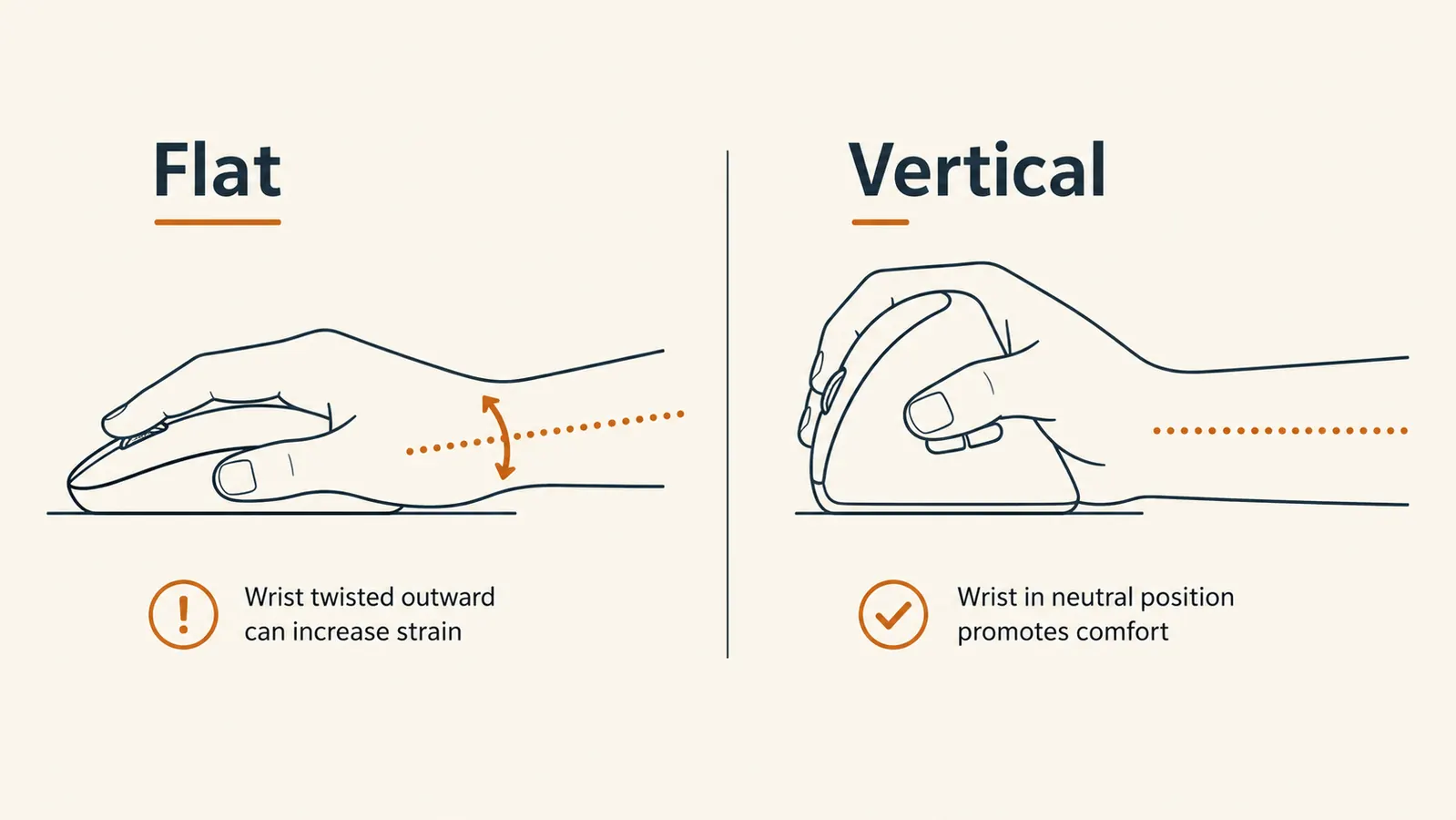
What I'd Look For in Any Mouse
If you're still comparing, or you're not sure which side of this split you're on, here's the checklist I'd run any new mouse against before it earns a spot on my desk. Grip angle first, because that's the whole ballgame: your hand should sit neutral, not twisted to one side. Second, size, because a mouse that's too small or too big for your hand makes you grip harder than you should. Third, the buttons and the wheel, because you live on them all day and a stiff, noisy switch grates after a few hours. Fourth, power, because the worst tool in the world is the one that dies on you mid-afternoon.
The Lift covers all four about as well as anything I've tried. It comes in a medium and a smaller size, so it isn't pretending one fit works for everyone. The buttons are quiet enough that they don't wake Dozer off the concrete when I'm working late. And it's on good terms with a battery that lasts for months, which matters to me because I'm not the guy who remembers to charge things. If you can name what your hand is flat against all day, you can usually tell pretty fast which box a given mouse is going to check, and which one it'll miss.
Set It Up Like You Mean It, or Skip It
Here's the thing about an ergonomic mouse: it only does its job if you set it up right, and most folks don't. The Lift wants to sit at the front edge of your desk so your forearm rests on the surface and your hand drops down onto it, not reaching forward like you're grabbing for something across a bench. If it's too far in, your shoulder hunches up and you've wasted the whole point. Set your chair or your desk height so your upper arm hangs relaxed and your elbow sits at about a right angle.
Don't chase perfect, because perfect doesn't exist and obsessing over it is how you give up on a good tool. Good enough is fine. The point is your wrist stays neutral and your forearm stays roughly straight, and the Lift makes that easy in a way a flat mouse never does. You don't have to be a tech person or study your own posture like a project. Just slide it to the front edge, sit up, and let your hand find the grip. Your body knows what it wants. The right tool just has to stop fighting it.

Who Should Buy Which
Here's how I'd split it if you were standing in my garage and it was my money. Get the Logitech Lift if your shoulder, elbow, or forearm complains by Friday, or if you sit with a mouse for hours a day doing orders, bookkeeping, writing, or video calls. Those are the people who feel the flat mouse doing them dirty over a week. It's a comfort tool first, and it earns its keep the same way a good wrench does, by saving your body rather than testing it.
Stick with a classic flat mouse if yours gets light use, if speed and a familiar feel matter more to you than comfort, or if you're gaming and want that quick, precise control. There's no shame in it. Not every job needs the special tool, and that's the whole lesson from a lifetime of turning wrenches: you reach for the right tool for the job, not the fanciest one in the box. If you want the full day-by-day account of six months with this thing, my long-term review of the Lift has all the slow, useful detail. And for the parts I'm less excited about, the honest review of the Lift tells you where it falls short.
The Bottom Line
So, flat mouse or the Lift? For me it stopped being a question around the three-week mark, when I realized I'd stopped thinking about my right hand entirely. That's the quiet test that matters most: you shouldn't be thinking about your mouse at all, let alone the ache it leaves behind. If you're on the fence, this is the one I'd reach for. It solved the only thing that was actually bothering me, which is more than most gadgets ever manage.
Try the Lift on Your Own Wrist Before You Say No
The only test that matters is the one over a week, not an afternoon, and mine came back on the Lift's side. If your forearm does the talking at the end of a long week, this one is worth a run on your own desk.
Amazon Check Today's Price on Amazon →