

Twelve months ago I cleared a corner of my workbench, set down a laptop, and built myself a home office for the first time in my life. The reason wasn't ambition. Two of my parts suppliers and one hot rod client decided they wanted video calls instead of phone calls, and the kitchen table was no place to do real work, especially with Dozer sprawled under it and the dog hair working into every invoice. So there I was, a heavy equipment mechanic with grease permanently under my nails, picking out a keyboard. I figured if I was going to sit at that desk for hours a day, I was going to own something that felt like a real tool, and I ended up with a Redragon K580. A full year later, every word of this review is typed on that same keyboard, out of a garage I also use as a hot rod shop.
I'll be straight about how I judge a piece of gear, because it matters for everything below. I ask three questions. Does it hold up? Is it built right? Would I reach for it over the thing I had before? A keyboard, judged that way, is a tool like any other, and that is exactly how the K580 has been treated in my shop. It lives at that bench desk next to a half-open parts catalog and a coffee cup that I keep deliberately across the bench, because I believe in giving gear a fighting chance. Dozer has slept through roughly every hour I've spent at that desk, and honestly his tolerance is one of the bigger compliments a piece of hardware can get around here.
The Quick Verdict
A year of daily order entry, invoices, and correspondence later, the Redragon K580 is the office gear I'd defend first. It's heavy, it doesn't flex, the switches still feel as firm as the day they arrived, and the letters on the keys are still legible. It has honest wear-outs: the sound is louder than an office keyboard, the software for the extra buttons is clunky, and the most-used keycaps shine a little. None of it has ever made me want to switch.
Amazon Check Today's Price →Still typing on a board that bends in the middle? Here's what a year of a mechanical keyboard did for me.
The K580 has sat on my bench for a year and hasn't given me a reason to pull it. If you're setting up a home office for the first time, this is the gear I'd point you to first. See today's price and current availability on Amazon.
Amazon Check Today's Price on Amazon →How I've Used It
I'm at that desk most days by an hour or so after first light. I punch in the early parts orders that came in the night before, I work through the email stack, and I draft quotes for the hot rod restorations waiting in the next bay over. In the afternoon it's estimates and invoices, and at night, if a video call with a supplier runs long, I'm still doing it by the light of the monitor. A typical day puts two or three solid hours into my hands, plus the thousand small slips of hunt and peck while I look something up on the second screen. That's not gamer typing. It's office typing, real hourly volume, and it's the test the keyboard had to pass.
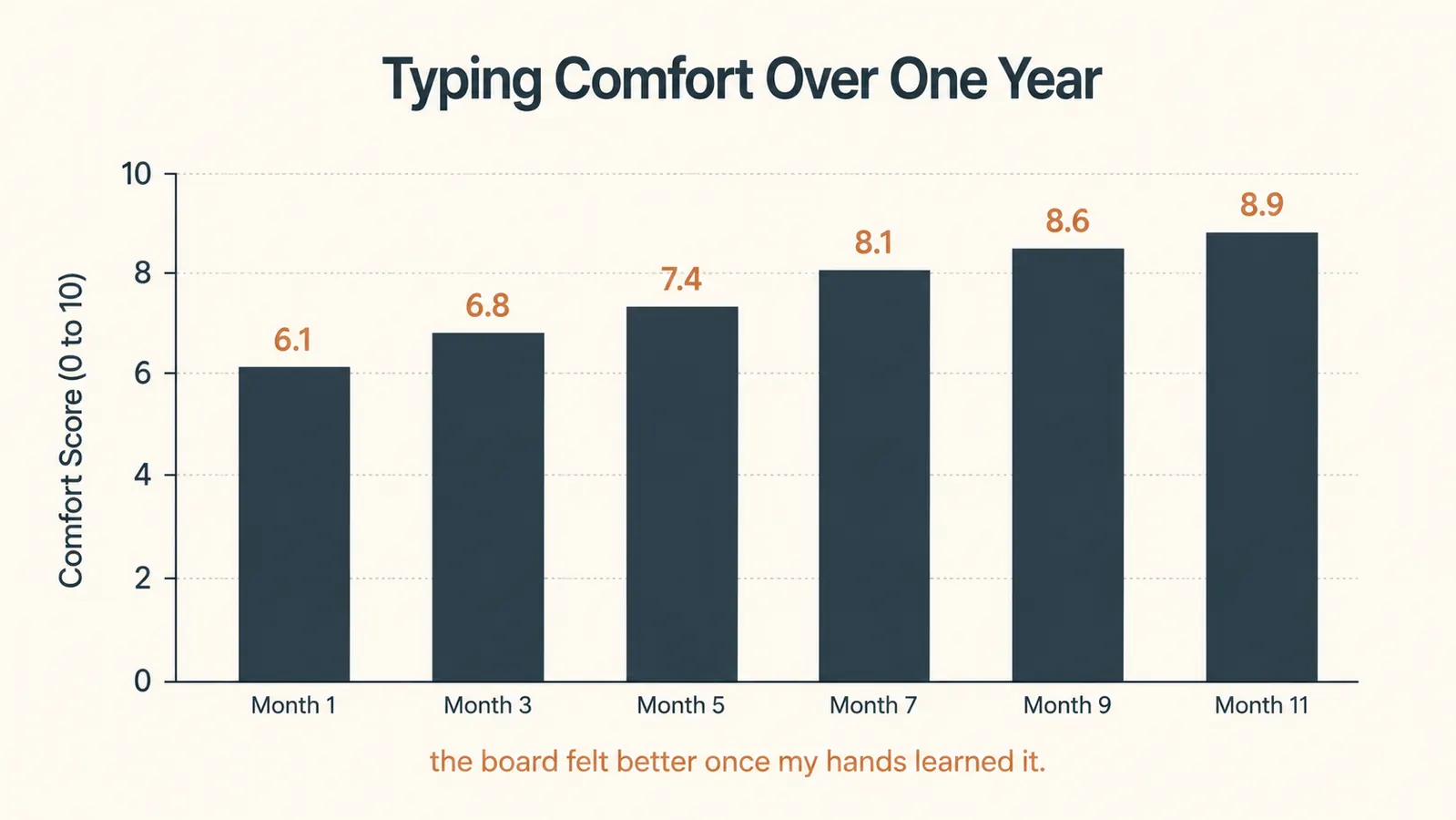
What surprised me about the switch is how uneventful it turned out to be, in the best way. After the first week of constant use I stopped thinking about the keyboard entirely, and that's the highest praise I have for any tool. The tool disappears and the work takes its place. I don't glance at the keys when I'm moving through a form the way I used to on a laptop. I don't press a letter twice because the response felt thin. My hands just go, and what comes out lands on the screen. For a piece of office gear to be set-and-forget is most of the story, and a year of slow seasons and busy seasons both have run through it now.

The Switches, a Year In
The K580 comes with proper mechanical switches under the keys. I won't pretend to be the kind of person who describes a switch with an accent and a tasting note; I'm the guy who just presses it. All I can tell you is that a mechanical key press has a firm, honest stop at the bottom, a bump and a click you can feel and hear, and then the next key is already waiting. That register has not changed since day one. Every key on the board, the letters, the numbers, the spacebar, still lands the same way it did on week one. When a tool says the same thing after a year that it said at the start, that's what 'built right' means to me.
The other half of it is what the keyboard doesn't do to you over time, and this is where it beats its own predecessor. A cheap rubber dome board isn't bad on day one, but there's a sponge under the keys, and a sponge loses its spring, and the lettering goes soft after you've mushed it to death for a year. You don't feel that happening, you just start pressing harder without realizing it. I went through that exact trade a couple of decades back with shop keyboards until I stopped pretending. If you're weighing the two designs yourself, I worked through the whole thing in a separate post on a Redragon K580 versus a cheap membrane keyboard.
The Build That Earns Its Place
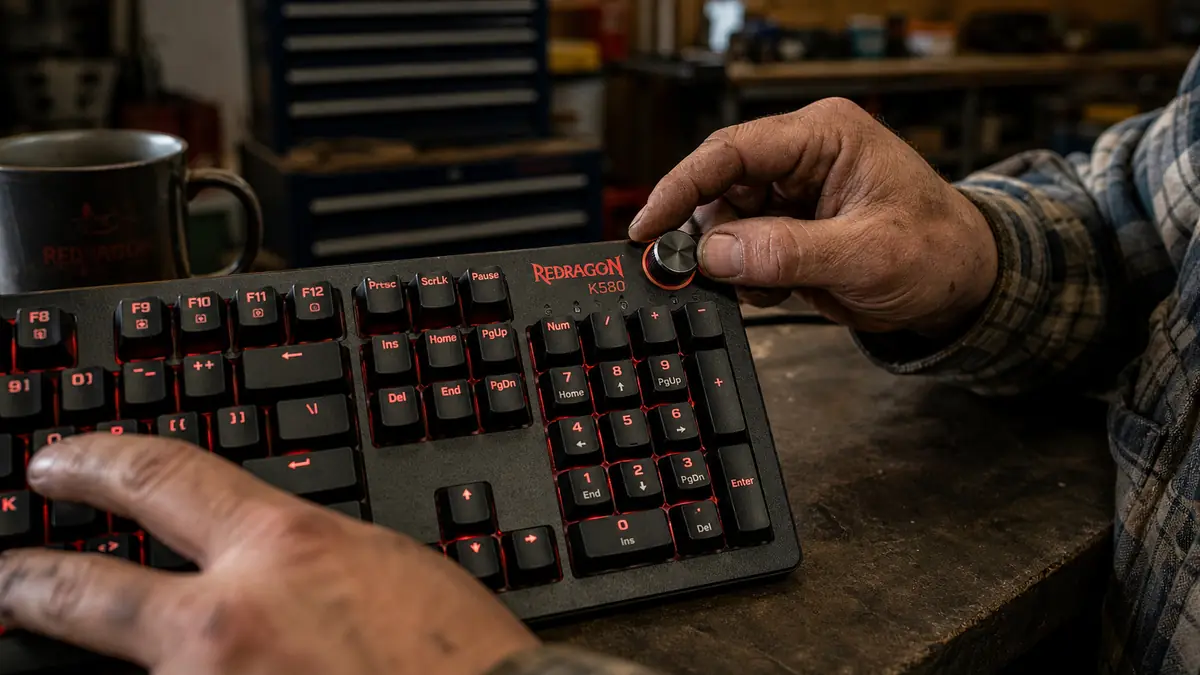
Pick this keyboard up and you'll feel it. There's a metal top plate that gives the board its weight, and weight and stiffness were the first things I noticed the day the box showed up. When I push a key down, the board underneath does not give, not a half a millimeter of flex in the middle. Mine sits on a workbench that is not perfectly level, the way any honest workbench isn't, and the rubber grips on the underside hold it flat and keep it from crawling when I'm working through a long stretch of numbers. For a man who has spent his whole life picking tools by how they feel in the hand, that's the whole ballgame. The board doesn't care where you put it.
I have never done more than routine maintenance to it. From time to time I blow the dust out of it with the same compressor I use on brake parts, and that is about the extent of the service it gets. It's wired, so there's no battery to babysit and no battery that slowly dies on you at the worst possible moment. There have been no sticky keys, no double strikes, no keycaps popping off, and no keys that quit. I bring that up because it's the boring part of an honest review: a lot of the value of this keyboard is in all the years I have not had to think about the thing failing.
The Light and the Wheel
I'll admit I didn't buy the K580 for the RGB backlighting. I set it to a steady red and left it there, because on a dark night in a converted garage a little red glow keeps the desk from feeling like the inside of a holesaw drawer. The brightness is easy to dial down, and it doesn't wash out the letters in any way that bothers me. If backlighting isn't your thing you can turn it off and never miss it, but sitting there all lit up when I'm doing a late stretch of paperwork, it's grown on me more than I expected.
The one extra I use every single day is the media wheel up top, which I've set to volume. On a light bar that thing turned out to be the difference between reaching for my headset controls and just running a thumb over the wheel while I'm mid-thought on a call. It's a small thing, but a tool that earns its spot every day is a tool you keep, and that wheel does exactly that. Simple, tactile, and it's never once fought me. On a bench that already holds a compressor, a torch, and a stack of ratchets, having something that just works without an argument is worth more than any gimmick.

Where the K580 Falls Short
The honest part starts here, because no keyboard is all praise and this one has real cons. The first is the sound. The K580 is not a quiet board. The switches click and the whole unit has a working clack to it that you will hear through a room. For a guy alone in a garage with a sleeping bulldog, that noise is fine, even pleasant. But if you share an office with someone on the phone all day, or you do late work while another person sleeps nearby, you will get sick of it fast. That is a genuine tradeoff, not a nitpick, and I'd be doing you a disservice to wave it off.
The second con is the normal grind of use. After a year the most-used keycaps have picked up a faint shine, the same wear a well-used tool always shows, and if you hold the board up to the light you can see it. The letters themselves have not worn off, which puts this well ahead of any budget keyboard I've owned, but the caps do polish up a little where my thumbs and forefingers live. It's cosmetic and it doesn't bother me. I'll mention it because it's the kind of detail an honest owner tells you about up front.
The third con is the software for the macro buttons. The five keys along the left edge can each be set to carry a command, and on paper that's a nice office trick, but setting them up means dealing with a separate utility you have to download, and it's clunky, dated, and not what I'd call intuitive. I programmed exactly one macro in week two, the keystroke I use at the end of every order confirmation, and I have not opened the software since. The good news is you never have to touch it to use the board day to day. The keyboard works fine with nothing installed. Just know the fancier side of it is more trouble than it's worth for a plain office guy.
What I Liked
- Firm, precise feel is identical after a year of daily use, no softening, no dead keys
- No flex and no crawling; metal top plate, real weight, and grips hold it flat on an uneven bench
- Wired, so no battery to babysit and no last-minute charge surprise
- Letters on the keycaps are still legible after a year of daily typing
- The media wheel earns real use daily and the backlight is easy to live with
Where It Falls Short
- Loud enough to annoy someone else in the same room, especially on calls
- The macro software is clunky, and I gave up on it after one setup
- The most-used keycaps pick up a faint shine from a year of wear
- The macro side is more headline than it deserves for a plain office setup
After twelve months and thousands of pages of orders, the best compliment I have for this keyboard is that I stopped thinking about it in week two and haven't had a reason to since.
Alternatives I Considered
The real question most people starting a home office ask first is whether a mechanical keyboard is worth buying at all, and that's the one I had to settle in my own head. The plain answer for me: if you spend hours a day at the keys, it's worth it, and if you only touch a keyboard twice a month, it isn't. I weighed just keeping the cheap rubber dome board that came with my old computer, and the deciding factor was that sponge under the keys. A sponge does fine at first and then quietly dies under a year of real volume. I want a key that says yes or no the same way at the end of the year as it did at the start.
I also peeked at a couple of wireless and higher-profile name brands while I was at it, and I came away with one clean takeaway for a garage bench: a wire is not a flaw. A wire never dies on you mid-order, never needs charging, and never gets lost under a pile of invoices. As for the more expensive names, I'll just say the price tag on some of them made me wince, and nothing I touched that week felt meaningfully better than what I ended up with. The K580 won because it felt built right the moment I sat down in front of it, and a year later it still does. Some tools you buy because they're cheap, and some you buy because they're honest. I bought this one because it's honest, and in an office full of things I know almost nothing about, that's the one quality I trust.
Who This Is For
This is for anyone who has just set up a first real home office and is discovering how much of the workday lives at a keyboard. If your day is invoices, order entry, estimates, and email, and you're tired of a wobbly lapboard or a laptop keyboard that makes an hour of work feel like pulling wire, for most people starting out, a Redragon K580 is the right place to begin, the tool that will disappear under your hands. I've put my thinking into why this whole category earns its keep in a separate list of the 10 reasons a mechanical keyboard is worth the money, if you need convincing before you spend.
Who Should Skip It
Skip it if your desk only ever sees an hour of typing a week, or if you already have a keyboard you love and no reason to change. Skip it if the sound matters, because this board clicks, and if someone shares the room, that clicking is going to be the thing they remember. And skip it if you were hoping the macro buttons and software would run your whole office by themselves, because that side of it needs more fiddling than it's worth. The K580 is a straight, honest keyboard for people who type for a living. If that's not your situation, you'll be happier holding on to your money.
A year of daily typing later, this is still the board on my bench.
If you've set up a home office and you're done fighting a flimsy keyboard, the K580 is the upgrade I'd buy again. Check today's price on Amazon and see if it's in stock.
Amazon Check Today's Price on Amazon →