

I spent most of my life judging keyboards the way I judge everything else: does it hold up, is it built right, would I reach for it over what I had before? For years the answer was no. I ran my paperwork off a cheap rubber dome board, the kind that bends in the middle if you hit the spacebar too hard. Then two suppliers and a hot rod client started asking for video calls, and I cleared a corner of my workbench and built a real home office for the first time. If I was going to sit there for hours, I wanted a keyboard that felt like a tool. I ended up with the Redragon K580.
The K580 is a full-size wired mechanical keyboard with proper switches under the keys, a metal top plate, and a few extras I'll get to. It's rated 4.6 stars across more than 4,300 Amazon reviews, which matters because that's a lot of people pushing the same keys I push. It has sat on my bench since, through slow weeks and busy ones, and I've got ten specific reasons this one stayed instead of joining the pile I threw out before it.
Done fighting a keyboard that bends in the middle? A mechanical board is the fix.
The Redragon K580 is the keyboard I reached for first when I set up my home office, and it's the one still on my bench. Full-size, wired, mechanical switches, rated 4.6 stars by over 4,300 buyers. See today's price on Amazon.
Amazon Check Today's Price on Amazon →Real Switches That Say the Same Thing a Year Later
What separates a mechanical keyboard from everything else is the switch under each key, a real spring-loaded mechanism instead of a rubber dome with a sponge behind it. A sponge has a honeymoon and then quietly dies under real volume. A mechanical switch has a firm, honest stop every single time, and mine still lands exactly the way it did the day the box showed up. I just press a letter and it says yes, and it has said yes the same way for a year.
A Metal Top Plate and a Board That Doesn't Flex
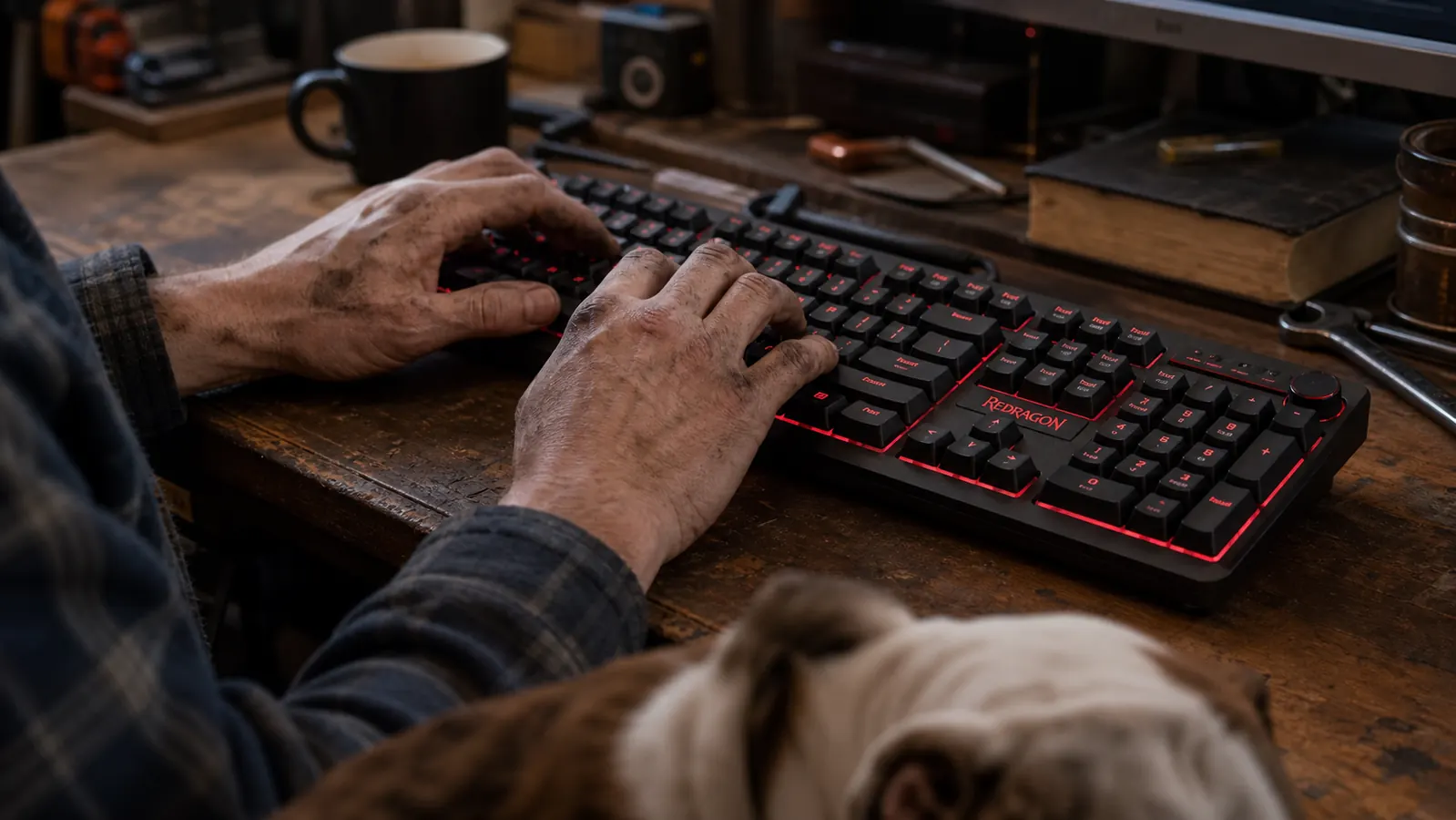
Pick a K580 up and you feel the weight before anything else. There's a metal top plate under the keys. When I push a key down, the board underneath does not give, not a half a millimeter of flex in the middle. My workbench isn't perfectly level, the way no honest bench is, and the rubber grips hold it flat without it crawling while I work through a stretch of numbers. For a man who picks every tool by how it feels in the hand, that's most of the argument.
The Letters on the Keys Don't Rub Off
A cheap keyboard's lettering goes soft and then disappears once you've mashed it for a year, and you never feel it happening, you just start hunting for the wrong key. On the K580 the letters are still legible after a year of daily order entry and correspondence. My most-used keycaps have picked up a faint shine where my thumbs live, just the normal polish a well-used tool shows, but the print is still there. For an office guy who types for a living, that's a real difference.
It's Wired, So There's No Battery to Babysit
Some people hear wired and assume outdated. I hear wired and think: nothing to charge, nothing to die on me mid-order, nothing to leave on the other side of the garage. It plugs in and it's done. I've had wireless gear decide the worst possible moment was a good time to run out of juice, and if my keyboard did that on a call with a supplier I'd have to apologize. A wire never does that. On a desk I share with a compressor, one less thing to charge is worth something.
Backlighting That Doesn't Wash Out the Letters
I didn't buy the K580 for the RGB backlighting, but it's grown on me. I set mine to a steady red and left it there, because on a dark night in a converted garage a little red glow keeps the desk from feeling like the inside of a holesaw drawer. The important part is that it doesn't wash out the print on the keys, the one thing that would make backlighting a waste. If it's not your thing, you flip it off and never miss it.
A Volume Wheel I Reach For Every Single Day
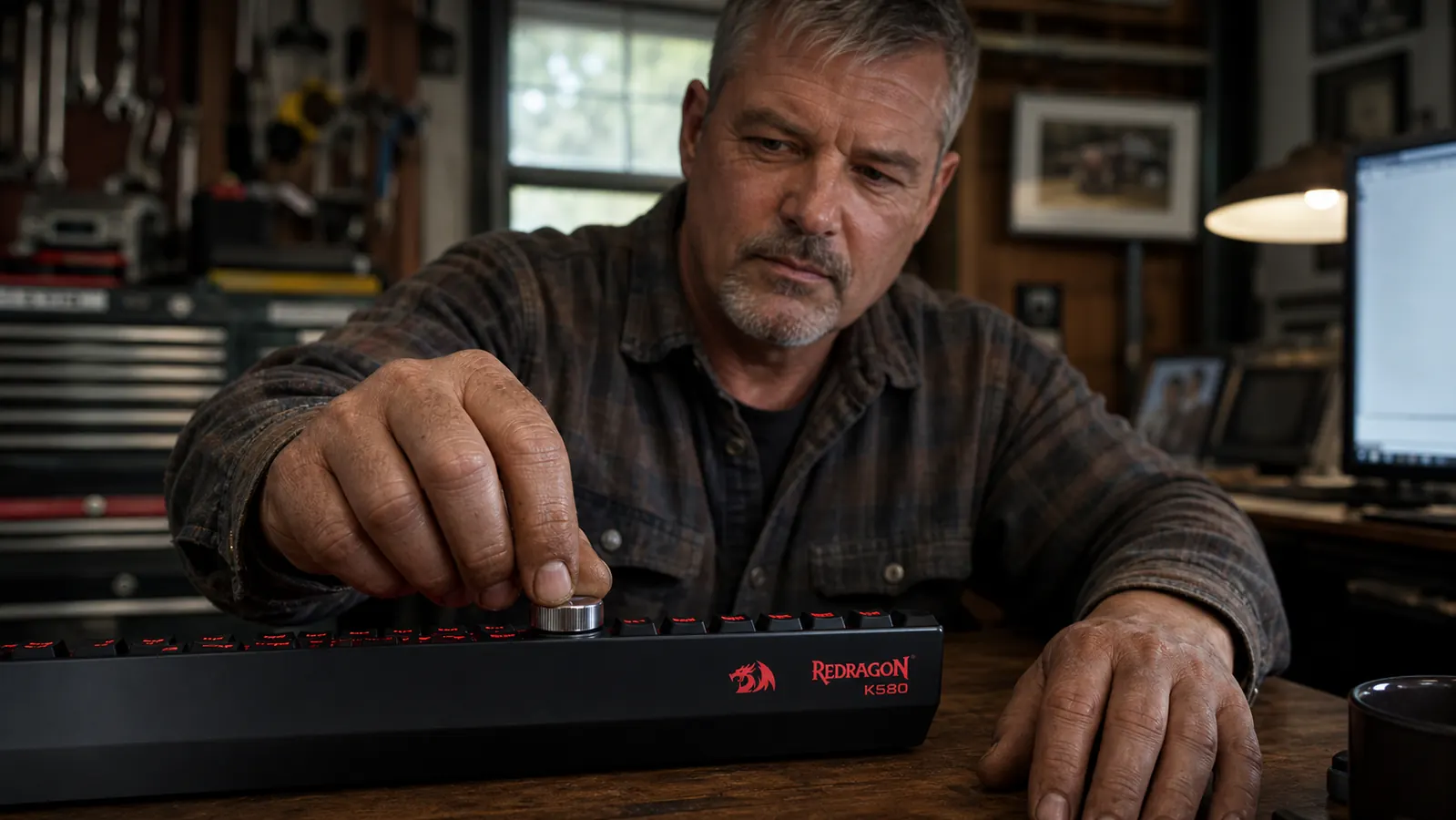
Up top on the K580 there's a metal media wheel I've set to volume, and it's the one extra I actually use daily. It's the difference between fumbling for my headset controls mid-call and just running a thumb over the wheel while I'm still thinking. It's a small thing, but a tool that earns its spot every day is a tool you keep, and that wheel has never once fought me.
It's Easier on Your Hands Over Long Stretches
A mechanical key bottoms out with a firm, predictable stop, so you're not mashing a spongy surface to make sure the letter registered. That means you press less hard, hour after hour, and your hands and forearms notice. I'm not going to sell you magic, and a keyboard alone won't undo years of turning wrenches. But if your wrists are talking back during long typing, a board you don't have to fight makes a real difference. I put together a guide on how to type without wrist pain using a mechanical keyboard if that's your situation.
It Disappears Under Your Hands So the Work Takes Over
The highest praise I have for any tool is that I stopped thinking about it. After the first week on the K580 I stopped glancing at the keys the way I did on a laptop, and I don't press a letter twice because the response felt thin. My hands just go, and what lands on the screen is right. A good tool disappears, and a keyboard that does that is doing its whole job. The last thing you want to be worrying about is the thing your fingers are sitting on.
One Honest Buy Beats Replacing Cheap Boards Forever
Here's the math that settled it for me. The cheap rubber dome boards I used before went soft and died on a regular schedule, so I was buying replacements like I buy gas. One solid mechanical keyboard that holds up for years is cheaper in the long run than a drawer full of disposables. I broke down exactly how it's held up after a year of daily use in my long-term Redragon K580 review, including the honest cons, if you want the full picture before you spend.
It Earns Its Place on the Bench
Every tool on my bench has to justify the space it takes up, and the K580 does. A year in, it's the one piece of office gear I'd defend first. No sticky keys, no double strikes, no keys that quit, no battery, nothing to service beyond blowing the dust out with the compressor I already own. There are honest tradeoffs, it's louder than an office keyboard and the macro software is clunky, and I cover those in my full review. But for a first-time home office, this is the keyboard I'd buy again tomorrow.
What I'd Skip
A mechanical keyboard isn't for everyone, and I'd rather be honest than push it on someone it won't help. Skip it if your desk only sees an hour of typing a week, because at that volume a decent regular keyboard will do. Skip it if you share a room with someone on the phone all day, because this board clicks and you will hear every key. And skip the fancy side of it if you hoped to program the macro buttons into running your whole office, because that software is more trouble than it's worth for a plain office guy. If you type for a living, the K580 is worth it. If not, holding on to your money isn't a bad call either.
The best compliment I have for this keyboard is that I stopped thinking about it in week two, and a year later I still haven't had a reason to start again.
A year of daily typing later, it's still the board on my bench.
If you've set up a home office and you're done fighting a flimsy keyboard, the Redragon K580 is the upgrade I'd buy again. Full-size, wired, mechanical switches, rated 4.6 stars by over 4,300 Amazon buyers. Check today's price and see if it's in stock.
Amazon Check Today's Price on Amazon →