

I will give you the names up front: a Quntis monitor light bar and an old swing-arm desk lamp I keep for carburetor work. That is what I am comparing, because that is what is on my bench.
When I set up my home office in the corner of my garage, the first thing I grabbed for light was an old swing-arm desk lamp I'd had for years. It was a decent lamp. Built solid, aluminum arm, a bulb I could actually buy at the hardware store. I figured light is light, and that lamp would do the job same as it always had.
It didn't. The short answer is that a monitor light bar and a desk lamp are not the same tool. They solve different problems, and if you spend your evenings at a screen the way I do now, the difference shows up in your eyes about an hour in. I ran both on the same desk, at the same time of night, for close to a month before I made up my mind. I'll tell you plain which one I'd buy again, and why.
Why I Even Bother Comparing Them
I should be clear about what I'm not doing here. I'm not some lighting snob. I'm a mechanic who builds hot rods on the side, and until I built this office I'd never once thought about where light lands on a keyboard. I judged the lamp the way I'd judge any tool: does it hold up, is it built right, does it earn its place on the bench. For years it did fine. Then my shop started taking video calls with parts suppliers and customers, and I started spending real hours at this desk, nights included.
That's when I noticed something that made no sense at first. Some evenings I'd sit down, pull up a parts diagram or an order screen, and my eyes would start to ache. I kept fiddling with the monitor brightness, turning it up, turning it down, never comfortable. It felt like a personal problem, my age catching up with me, until I realized the lamp sitting behind and beside the screen was throwing its light straight back at the glass. It was reflecting off the monitor and into my face, all night long, and I hadn't caught on for weeks.
So I gave the monitor light bar an honest shot. I'd seen them around and figured they were office-gadget nonsense, the kind of thing that looks clever in a catalog photo and gathers dust a month later. I was wrong about that, and this write-up is me owning it. I ran both lights side by side, switched back and forth, and kept notes like I would on a stubborn truck.
The Head-to-Head, in One Table
| What | Quntis Monitor Light Bar | Regular Desk Lamp |
|---|---|---|
| Where it mounts | Clips to the top of the monitor, no stand on the desk | Sits on the desk and takes up real estate |
| Light direction | Aimed down and slightly forward at the work surface | Fixed arm angle, lights whatever you point it at |
| Screen glare | Asymmetrical lens keeps glare off the screen | Rear-facing light shines right back into the glass |
| Desk space used | None, it hugs the top of the monitor | Base and arm take up a good chunk of the corner |
| Power source | USB cord, runs off the monitor or computer | Wall plug, so it works even with everything off |
| Extra tasks | Only lights the desk in front of you | You can swing it to light a part, a book, a note |
| Eye comfort on long sessions | Even light, no hot spot, fewer tired eyes | Bright spot plus screen reflection, noticeable after an hour |
| Best for | Desk work at a screen | Anything you want to point a bulb at |
Here's the straightforward version. If your desk is basically a screen and a keyboard, the light bar does the important job and does it well. If you need one light that can do a little of everything, the lamp still has a place. Neither one made the other worthless, and I'll get into both sides before I'm done.
How I Put Them Head to Head
I didn't want to trust my gut on this, so I made it a small experiment. For three weeks I used the desk lamp in the evenings, the way I had been. Same chair, same monitor, same paperwork. Then for three weeks I swapped in the Quntis light bar and left the lamp unplugged. I wrote down how my eyes felt at the end of each stretch, how often I found myself fiddling with brightness, and whether I had to squint to read anything.
I also paid attention to the practical stuff that nobody mentions in the marketing. How much desk real estate each one cost me. Whether the cord got in the way. How steady the thing sat, whether it wobbled or slipped. That's the part of any tool that tells you if it's built right or just built to look right in a photo, and I wanted to know it before I told anyone to spend their money.
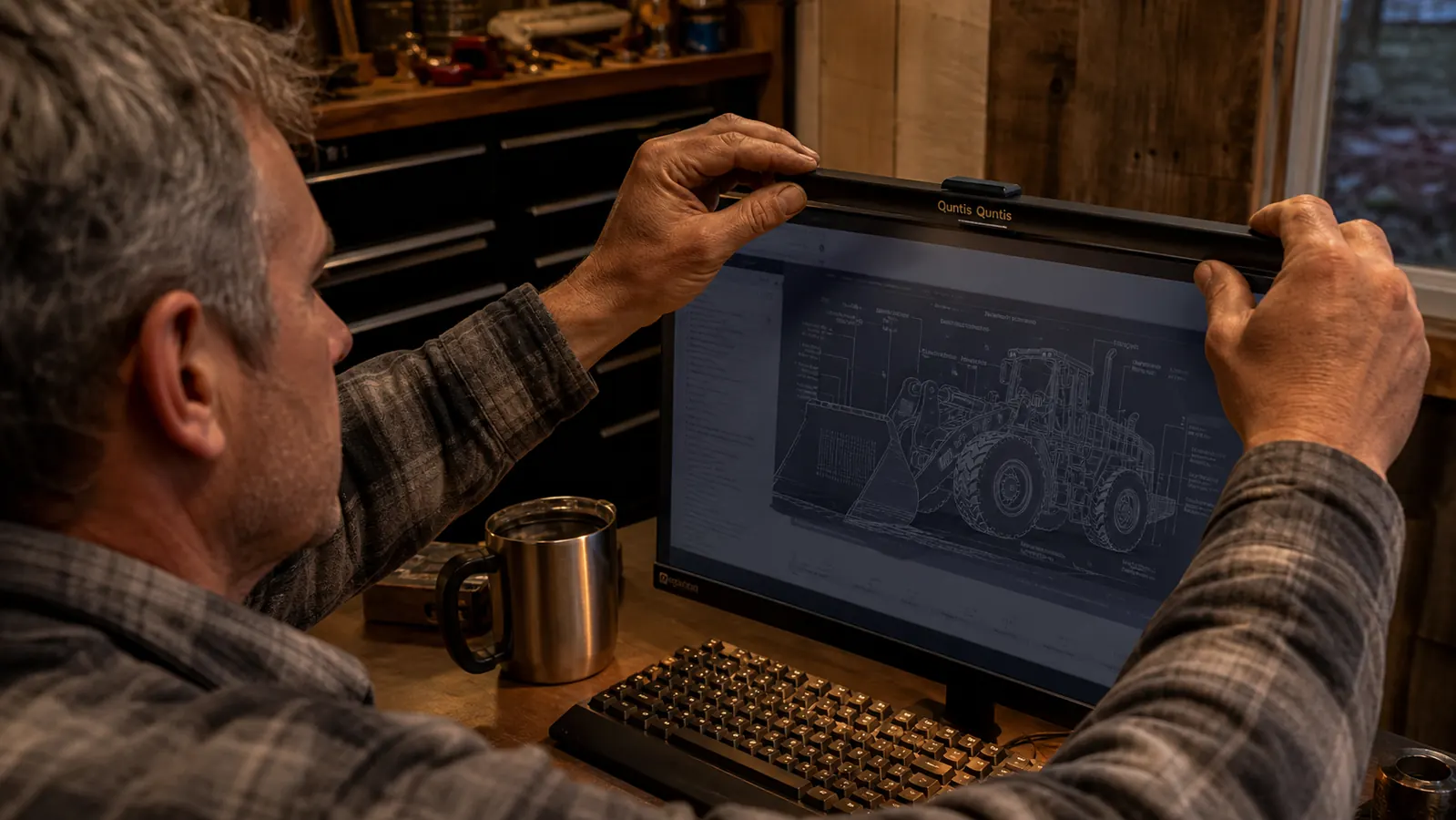
One thing I'll note that surprised me: the light bar is lighter than it looks and dead simple to mount. It balances over the top of the monitor with a curved counterweight, no tools, no bracket, no screwing anything into anything. I had it up in about thirty seconds, and it has not moved or slipped since. That's the kind of built-right simplicity I like, the same reason I trust a tool that doesn't need a manual to use honestly.
Where the Quntis Monitor Light Bar Wins
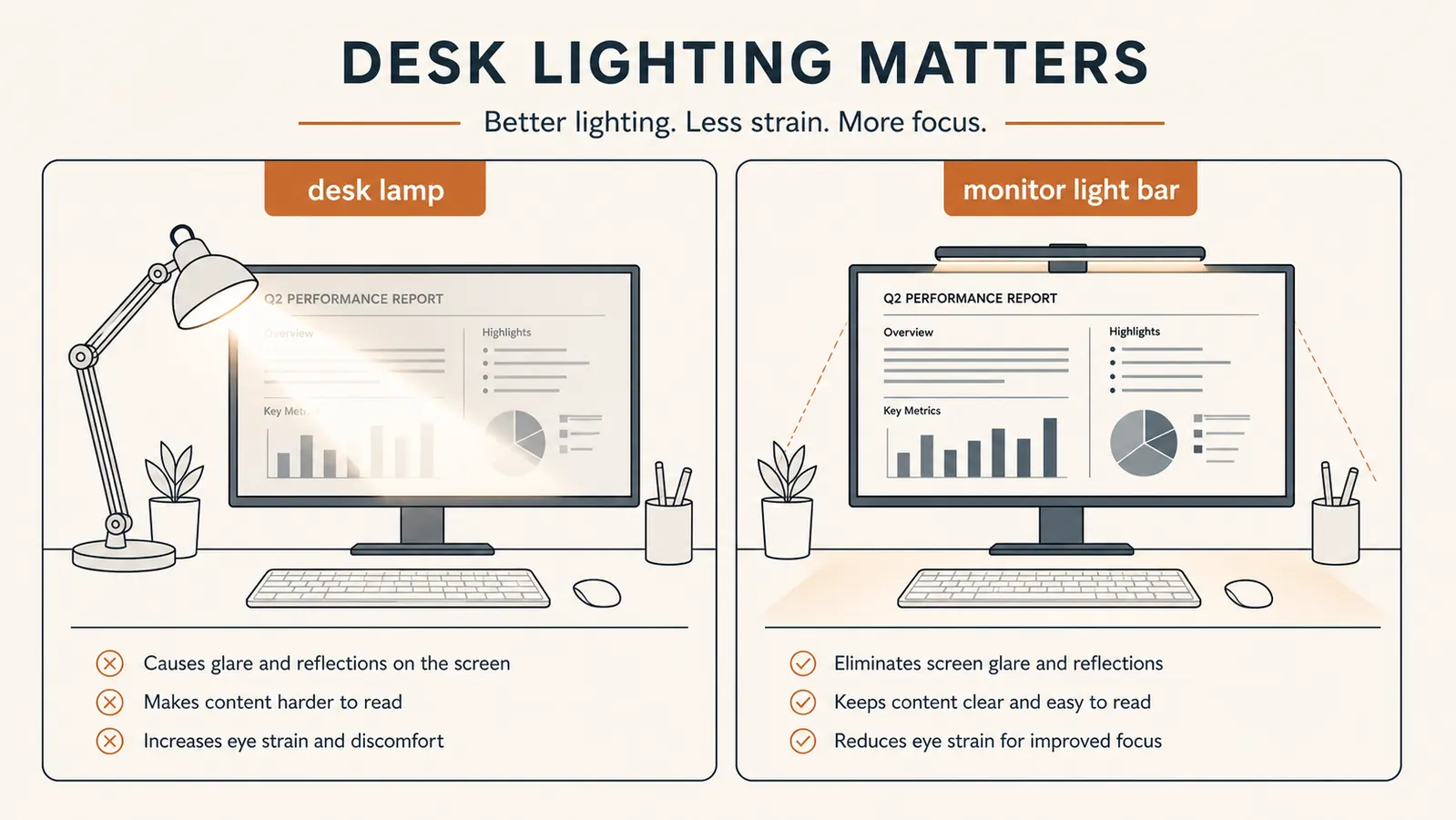
The big one is glare, and it's not close. The whole reason my eyes were hurting was that the lamp was lighting the back of my monitor, not my desk. A monitor light bar is shaped to throw its light down and forward, across the keyboard and paperwork in front of you, with an asymmetrical lens that keeps it off the glass. The milkiness across the screen went away the first evening. I stopped squinting, and I stopped touching the brightness button, because the screen finally read clean.
It also clears the desk completely. My bench is cluttered enough between work and the hot rods, and I've got parts, forms, a coffee mug, and a bulldog named Dozer who thinks the chair beside me is his. The lamp base took up a whole corner and its arm hung over half my work surface. The light bar clips to the top of the monitor and stays there, out of the way, taking up zero desk space and casting no shadow from my arm when I reach for something.
And the light itself is easier on the eyes. It's steady and even, not one hot bulb staring at you from an arm's length away. The auto-dimmer reads the room and adjusts on its own, which sounded like a gadget that would annoy me, but it works quietly in the background. On the nights I'm doing parts orders and estimates until late, my eyes aren't as fried at the end as they were with the lamp. That's the difference I actually felt, not the one in the manual.
Kill the screen glare and light the whole desk from one clean mount
I've run the Quntis monitor light bar on my screen for months now. If screen reflection and tired eyes sound familiar, this is the fix that earned its place on my desk.
Amazon Check Today's Price on Amazon →The desk lamp was throwing its light right back at my screen. I had been fighting a glare I didn't even know I had.
Where the Desk Lamp Wins
Now I'll argue the other side, because a desk lamp isn't worthless and I won't pretend it is. The lamp is movable, and that's a real advantage. I can swing it over to light a part number on a seized component, tilt it down to read a schematic, shine it into the guts of something I'm working on at the workbench across the garage. The light bar is bolted to the top of my monitor and it stays there. When I need light somewhere that isn't the desk, the lamp is the only one of the two that can come along.
The lamp also runs off the wall, so it works whether the computer is on or off. If the USB port feeding the light bar ever flakes out, the light bar is dead until I find another port. The lamp just keeps working, same as it always has. Simpler machine, fewer moving parts, nothing to plug into anything. For a guy who fixes things for a living, I respect that kind of plain reliability, and I'd be lying if I said I didn't get a little attached to a tool that never asked for anything.
I'll also give it the price point, honestly. A plain desk lamp is about as cheap as lighting gets, and you can buy a bulb for it at any hardware store on the way home. The Quntis light bar costs more up front because it's a more specialized tool. If all you need is to point some light at a corner of a room now and then, the lamp is all you need, and I'd tell you that to your face before I'd let you spend extra.

What the Light Bar Get Wrong
I want to be fair about the light bar's shortcomings, because no tool is perfect. For one thing, it's really only good for the desk it's attached to. It's a specialist. It won't light the other side of the room, and it won't help you see into the engine bay of the coupe sitting in the driveway. It earns its keep in one spot and won't go anywhere else.
The USB power is also something to plan around. It needs a live port, so it's tied to the computer being on or a powered hub you remember to leave on. If you're the kind of person who shuts everything down at the wall, you'll want to think about where it pulls power from. It's not a dealbreaker for me, but it's a real consideration, and anyone who tells you a USB light bar is exactly as simple as a lamp is selling you something.
Who Should Buy Which
If your whole desk life is a computer, if you send emails, do paperwork, and stare at a screen for hours at night, buy the monitor light bar. It takes the glare off the glass, clears your desk completely, and is genuinely easier on your eyes over a long session. That's me, and that's why it's the one I reach for every evening now.
But if you need light for all kinds of jobs, not just the screen, keep a good desk lamp close by too. They're not rivals so much as they're different tools in the same box. I run the light bar on the monitor, and the old lamp sits on a shelf for the nights I need to light up something in my hands instead of on the desk. Both have earned a place in this garage, and I'm not getting rid of either.
Me, I'd buy the Quntis again in a heartbeat. It solved a problem I didn't even know I had, it's built solid enough to live on top of my monitor for years, and it did the one thing a lamp never could: it stopped the glare that was wearing out my eyes every night. If you're tired of squinting at a washed-out screen, that's the one to start with.
Take it from a guy who buys tools for a living: you don't need a pile of gadgets to get a good office light, you just need the right light for the thing you're doing. If that thing is staring at a screen for hours, the monitor light bar is built for exactly that job, and it does it better than the lamp ever did. Your eyes will thank you sooner than you think.
Put a clean light on your screen and save your eyes
The Quntis monitor light bar is the tool I'd put on any desk that sees nightly screen time. Check today's price and see if it's time your lamp traded its spot on the desk for one on the shelf.
Amazon Check Today's Price on Amazon →