

Three months into setting up a real home office in my garage, my neck started complaining before the coffee did. I'd sit down to take a video call with a parts supplier, look down at the screen the way you'd look down at an engine block, and by noon I was rolling my shoulders and rubbing the back of my neck. That's the whole problem with a laptop sitting flat on a desk. The screen lands wherever the tabletop is, and for a grown man at a standard desk, that's low enough to keep your head pitched forward for hours. I'm not a posture guru and I don't pretend to be, but I know a thing or two about a part that's working against you. It took me a while to stop treating this as a discipline problem and start treating it as what it actually was: a height problem that needed a real fix.
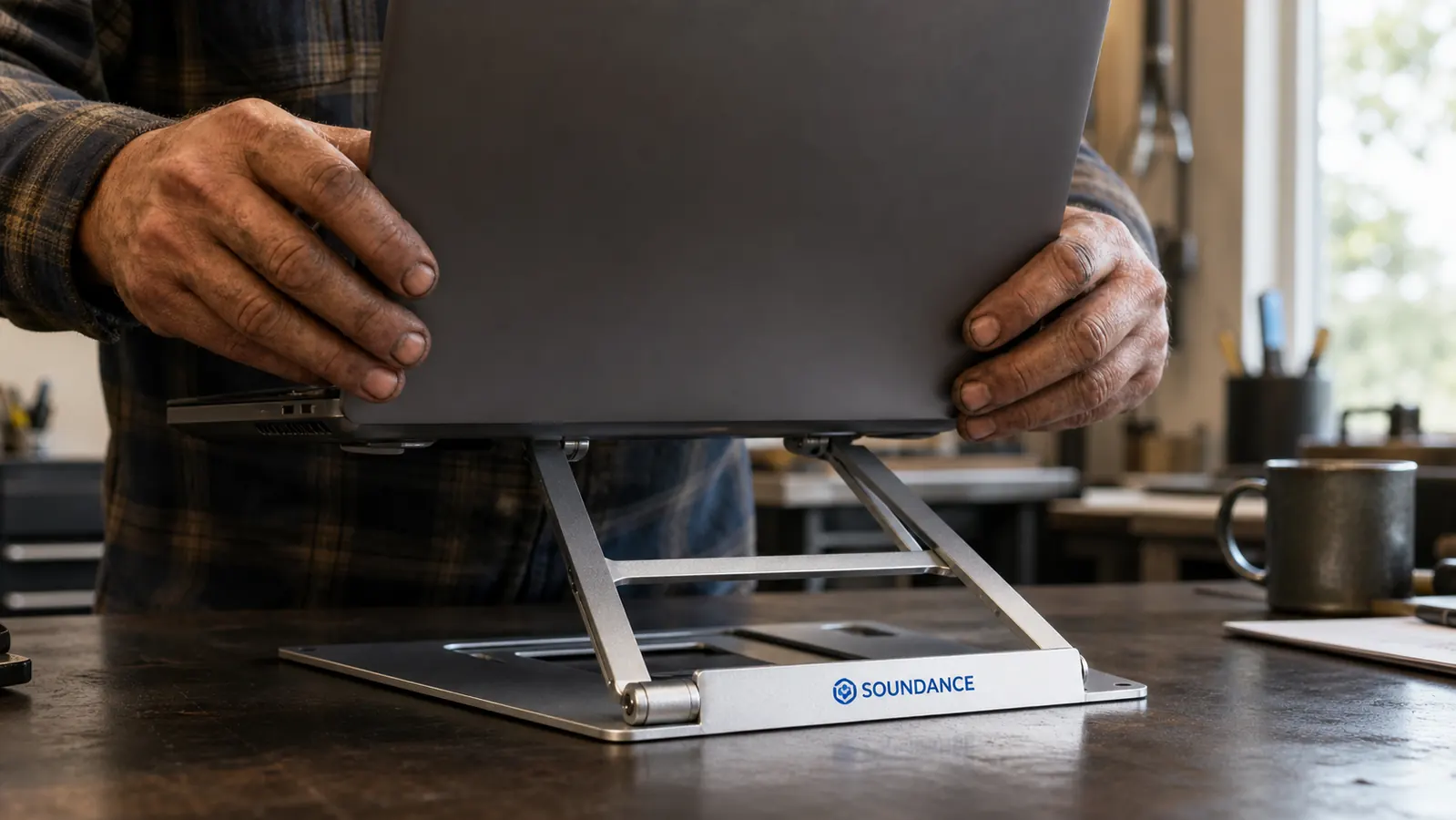
Here's what finally worked for me: a SOUNDANCE aluminum laptop stand. I spent weeks trying to fix my neck with pure stubbornness, sitting straighter, leaning back, craning my chin up. None of it stuck, because the screen never moved an inch. The stand got the top of that screen up to eye level so I stopped staring down at it, and it did in one afternoon what three weeks of good intentions never did. It's built like a tool and it holds its setting. I'm going to walk you through the exact way I set mine up, in the order I did it, so you don't have to bring your neck along for the ride.
Raise That Screen Today With a Stand Built Like a Real Tool
You can't fix your neck staring down at a screen that never moves. A SOUNDANCE aluminum laptop stand is milled and stiff, with rubber pads and a hinged brace that locks, so you set the height once and it holds. That's the foundation every step below builds on.
Amazon Check Today's Price on Amazon →Step 1: Measure Where Your Eyes Actually Sit, Not Where You Think They Sit
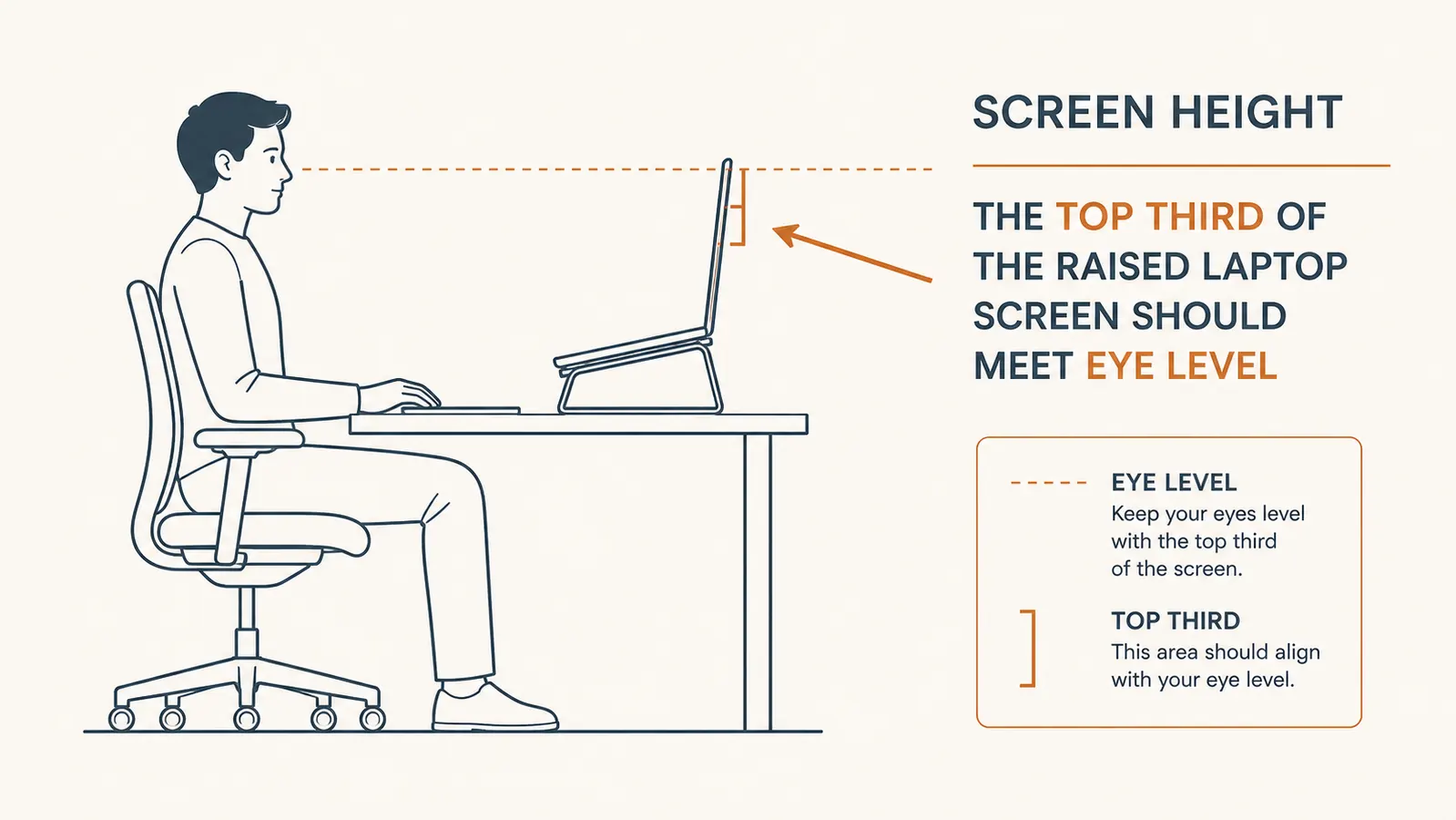
Before you buy anything, figure out the number you're actually trying to hit. Sit down in your office chair the way you really sit when you're working, not the way you sit when someone's watching. Close your eyes, relax your shoulders, let your head settle where it naturally wants to be, then open your eyes and look straight ahead. The spot your eyes land on, dead level, that's your target line. Write that down or just remember it, because it's the whole ballgame.
Now look at your laptop screen. The rule that made sense to me is that the top third of the screen should sit around that eye-level line, so you read slightly downward instead of staring straight down at the keyboard. On my desk that worked out to needing the screen raised about seven inches off the tabletop. That's not a number I guessed, it's a number I measured by stacking old shop manuals under the laptop until my neck finally quit. The exact height doesn't matter as much as the direction: anything that gets the screen up toward your eye line beats the craned-neck setup you have now. If you share the desk with anyone, do this measurement for each of you, because what works for my frame won't line up the same for somebody shorter. The stand is the same tool either way, you just set it to a different notch.
One trick that saved me from overthinking the measurement: if you don't trust your own feel, prop your phone on the desk facing you and glance at the camera for a moment. When you can see your own eyes looking level into the lens instead of down at the keys, you've found the line. I did it once at the start and never needed to again, because after that the stand held the answer for me.
Step 2: Set the Stand So the Screen Lands on That Line and Stays There
This is where a flimsy stand shows its hand. The whole point of a hardware fix is that it holds its setting, day after day, without you having to babysit it. The SOUNDANCE stand I settled on has a hinged brace that locks into a handful of height positions, so you set it once and it doesn't sink or slip. I've got a 15 inch work laptop on mine, and it hasn't sagged a quarter-inch since I set it. That's the thing I judge a tool on: does it hold up, or does it just look the part on day one?
Set the stand to the height you measured in the first step, set the laptop down on the rubber pads so it can't slide, and then do the real test. Open your email or a parts diagram and work for ten honest minutes. If your head is level and your neck is quiet, you're close. If you're still creeping forward toward the screen, nudge the stand up one notch. Give it a couple of days in that setting before you make up your mind, because your body picks up habits slower than you think, and a day of real relief is a better judge than ten minutes of paying attention.
Step 3: Get the Laptop Close Enough, Not Just High Enough
Raising the screen fixes the up-and-down problem, but it introduces a second one if you're not careful. The moment you lift that screen off the desk, the keyboard goes up with it, and now your hands have to float up to type. That's why the step that matters as much as the height is pairing the raised screen with a separate keyboard and mouse down at desk level, so your arms stay in a relaxed position. If you type on the laptop's built-in keyboard while the screen is propped up seven inches, you've only traded a neck ache for a shoulder and forearm ache.
My own setup is a laptop on the stand dead center, a plain keyboard in front of it, and a vertical mouse off to the side. Keeping my forearms roughly level with the desk and my wrists straight is the same principle I use on any tool bench. The stand does one job, getting my eyes level, and it does it well. Let the separate keyboard and mouse do their job of keeping your hands comfortable, and your whole upper body stops doing overtime. Dozer the bulldog doesn't care about any of this, he's just asleep on the concrete, but I pay attention to it because I live on my hands for a living.
If you're not sure whether you've got the screen too tall now, watch your own shoulders for a few minutes. The giveaway is when your shoulders hike up toward your ears and hold there while you type. That means the keyboard and mouse have floated up too far, and you need to either drop the screen down a notch or bring the keyboard up. The goal is a screen tall enough for your neck and a keyboard low enough for your arms, and the two don't have to live on the same level. That's the whole trick of using the stand: it lets you separate the two.

Step 4: Watch the Heat, Because a Raised Laptop Runs Freer
One thing people don't talk about enough with a raised laptop is airflow. When a machine sits flat on a desk, the desk itself acts like a big heat sink and the vents underneath get choked off. When you lift it up so those vents have room to breathe, that's mostly a good thing, the fans can actually pull air. But a cheap stand that holds the laptop by clamping its edges can block the bottom vents, which is exactly backward. It looks fine sitting there, and you find out later that your machine is running hot under a load.
The SOUNDANCE model holds the laptop on two rails with the bottom mostly open, so the fans underneath get air. That matters if you run the thing hard all day the way I do, with estimating software and video calls open at once. In a year of daily use, mine has never gotten hot enough to worry me, and the rubber strips keep the machine from rocking even when I'm tapping fast. It's a small thing, but on the bench I've learned that the small things are usually what bite you in the long run, so I'd rather a stand leave the vents alone than look pretty and cook my machine.
Step 5: Set It Once, Then Give It a Fast Check Every Morning
The last step is the easiest, since the whole point of a good stand is that you do it once and forget it. Mine lives on the desk at the same height all the time, so every morning I just set the laptop on the pads, give the hinged brace a quick wiggle to confirm it's locked, and get to work. There's no ritual and no fancy morning routine. A hardware fix earns its place by never making you think about it, the same way a good torque wrench doesn't make you think about it, it just clicks and holds.
The only maintenance I've done in a year is wipe the dust off the aluminum every so often, same as I'd wipe down a tool chest. It folds flat if I ever want to move it, though it hasn't left the desk since the day I set it. I quit measuring my setup by whether it looked the part and started measuring it by whether my neck still hurt at noon. Once the screen got up to eye level, it didn't. That's the test I use on everything in the office, and this thing passed it and kept passing it.
I quit measuring my setup by whether the stand looked the part on the desk. I measured it by whether my neck still hurt at noon. Once the screen got up to eye level, it didn't. A year later, this laptop stand still hasn't let me down.
What Else Helps
Raising the screen was the biggest single fix for my neck, but it wasn't the only piece. If you're setting up an office from scratch the way I was, a couple of other things pull their weight. A chair that keeps your lower back from slumping matters, since all the screen height in the world won't save you if you're sitting on a kitchen chair with your back bent like a question mark. And if you're on a concrete floor all day like mine, something soft under your feet goes a long way toward keeping your legs from complaining by late afternoon. None of it has to be fancy, it just has to be built right, which is the standard I hold everything to.
I've written all of this down in a few other places around the site. If you want the longer argument for why a real aluminum laptop stand beats the stack of shop manuals that got me started, that piece is worth a read. And if you're the kind of buyer who wants the honest gripes before you commit, the full review of the SOUNDANCE stand covers the build, the grip pads, and the handful of small complaints I have with it in a lot more detail. The short version is that this is the tool that finally got my head level, and a year later it still hasn't let me down.
A Level Screen Is One Built-Right Stand Away
If you're tired of craning your neck at a laptop that sits too low, this is the fix I've used every workday for a year. The SOUNDANCE aluminum stand is built like a tool, locks its height, and holds a full-size machine without a wobble. Check today's price and meet me back at the bench.
Amazon Check Today's Price on Amazon →