

For the first month I ran my home office out of the shop, I propped my laptop on a stack of old shop manuals. It worked about as well as a pipe wrench with a rounded-off head, which is to say it sort of worked and it made everything worse. The screen sat too low, so I hunched over it the way I hunch over a transmission. The stack wobbled every time I reached for a part. And when Dozer, my bulldog, flopped against the desk leg, the whole tower of books took a half step sideways and took the laptop with it.
I could have grabbed any of the foldable risers they make for laptops. But I judge gear the way I judge tools. I wanted one solid piece of metal built to sit on a bench and stay put, something that would not slide, flex, or give up when I was in the middle of quoting a job. That is how I ended up with the SOUNDANCE aluminum laptop stand. After a year of daily use, it owes me a fair write-up, the same kind I give any part that has earned its place on the bench.
The Quick Verdict
A slab of solid aluminum that raises the screen to a comfortable height and has not flexed, wobbled, or let go of the laptop in a year of daily use. It is the rare piece of desk gear that feels like a real tool.
Amazon Check Today's Price →Stop Hunching Over a Laptop Lying Flat on the Desk
After a year of daily use, I can tell you plain that the cheapest fix in my whole home office turned out to be the best one. If your neck aches by lunch and your laptop still sits flat on the desk, this is the piece to start with.
Amazon Check Today's Price on Amazon →How I've Used It
The story of this stand is the story of my shop turning into an office on the side. I still do the mechanical work, but more and more of my day is parts catalogs, video calls with suppliers, and quoting jobs for the hot rods I build for customers. That work happens at a desk I built across from the tool chest, and the laptop is the whole rig. No docking station, no second monitor, just the computer I carry in and out of the truck.
So the stand has had one specific job for twelve months: hold the laptop at a height where I look at the top of the screen with my head level instead of tilted down. It handles my fifteen inch laptop on the lower row, and on cold mornings when I work from the table in the house it comes over without a fuss. It is not bolted to anything. It just weighs enough and grips well enough to stay where I put it.
I say that first because a lot of reviews read like the stand did the job on day one and that is the whole review. The real question is what a piece is like several hundred days in, and that is the part I can answer from where I am sitting now.
Why Raising the Screen Is the Real Fix
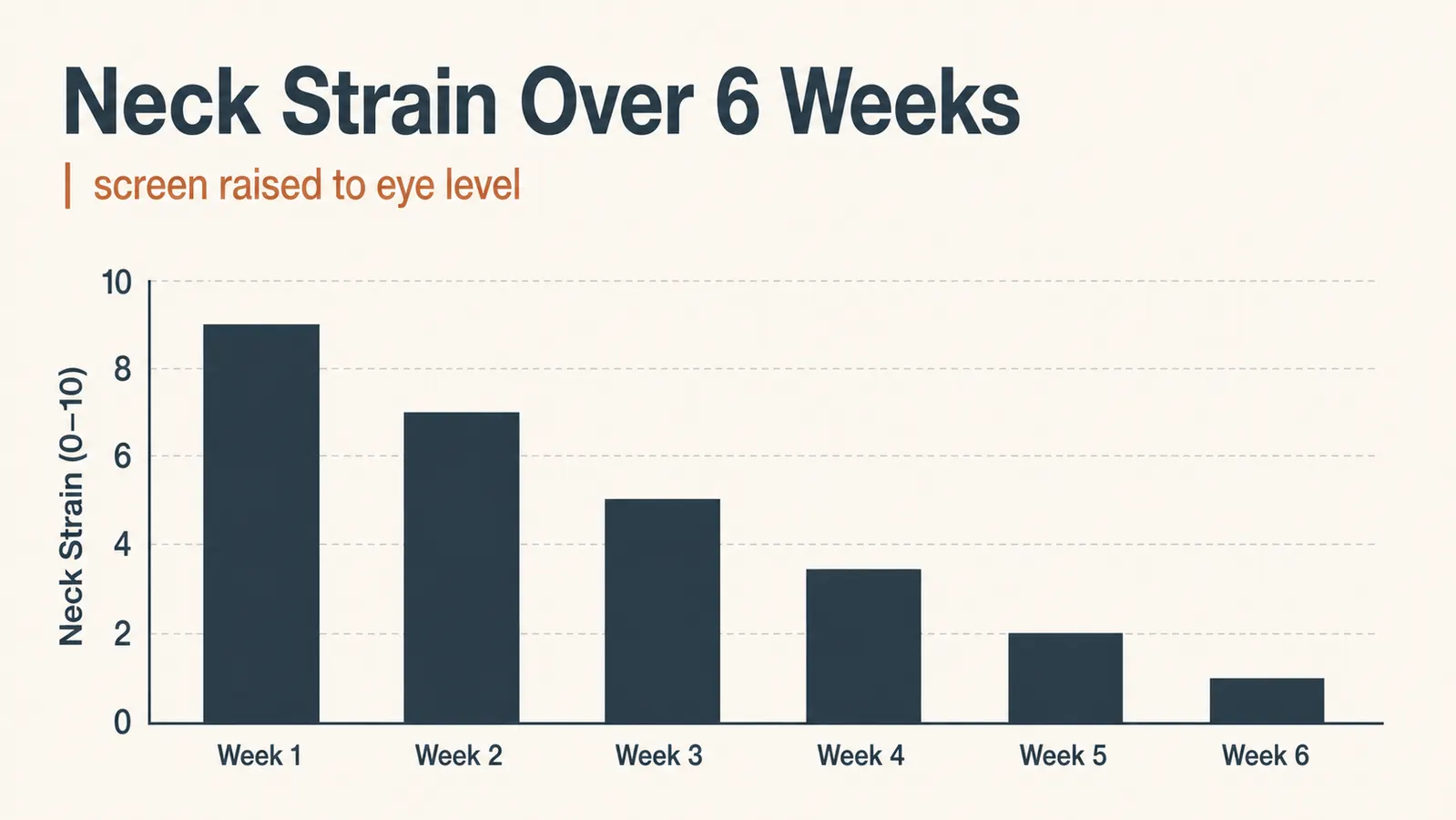
Here is what I did not understand until about six weeks into the office experiment. A laptop on a desk puts you in a lap-reading posture, and that posture grinds on you in a way that creeps up. My neck was sore every evening, not the sharp pain from a bad lift, just a dull ache that told me I had been staring down at a screen for four hours. I know drivers, and I know what a constant forward tilt does. That forward tilt lives in the neck and the back of the shoulders.
The fix is not a clever one. You want the top edge of the screen roughly level with your eyes, and then you sit back so your neck holds its natural position. The SOUNDANCE stand raises the laptop about six inches at the back edge, and because the front edge sits low, the screen winds up right about eye level on a desk I set to my own height. Within two weeks the evening ache was gone and I was not even thinking about it. The day I stop thinking about a part is the day it was the right part.
The height is personal, so I will give you the honest version. I am an average size man and it landed exactly right for me. If you are built taller, you may want the upper row or a taller chair. If you are shorter, it will sit a little high. I checked the height against a stack of manuals before I bought, and I would tell anyone to do the same. Measure the stack you are used to, then buy for that number.
One benefit I did not expect showed up on the video calls. With the screen up at eye level, I look at the camera square instead of down into a webcam, and my suppliers stopped telling me they could only see the top of my head. That sounds like a small thing, but it is the difference between being taken seriously and not. For a man who has spent his life being judged by the work on the bench, that one caught me by surprise.
Built Like Something That Belongs on a Workbench
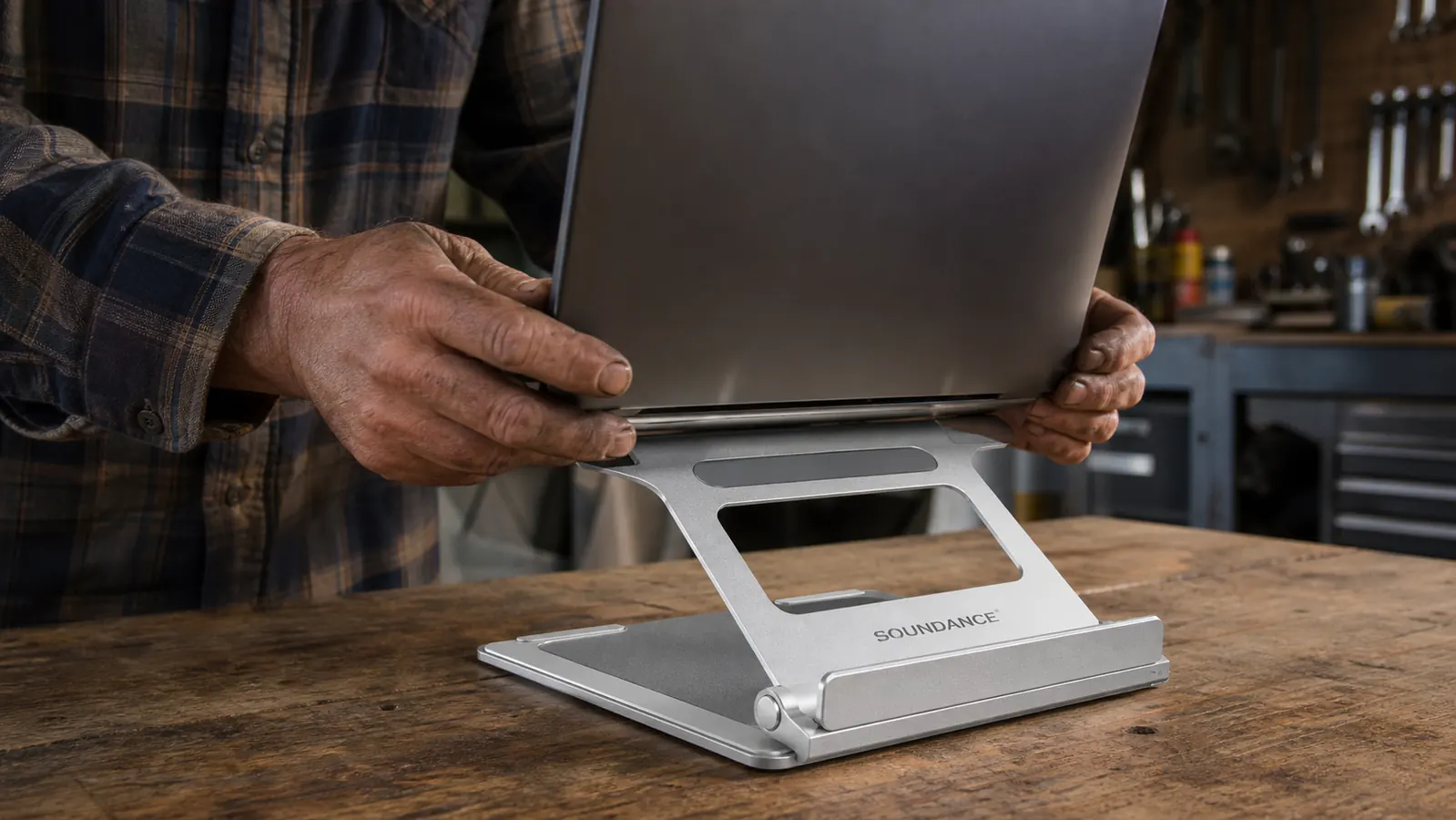
What sold me before I had used it a full day was the mass. This is not a painted plastic wing the size of a dinner plate. It is a slab of aluminum with real weight to it, the kind of material you would nod at for a mount bracket. It has the heft you expect from a tool, so it does not need to be anchored. It sits where you put it and stays there.
The laptop rests against a low rail with a row of rubber pads along the bottom, and four smaller pads at the back edge. The pads hold the machine as if it were shaped to it. The laptop does not slide when I pound the desk after a vendor quote goes sideways, and it does not slide when Dozer flops against the leg. I have not had to tighten anything because there is nothing to tighten. It comes out of the box built, and a year of sitting here has not changed that.
There is one thing people always ask, and that is whether a metal stand will scratch the laptop. Mine has not left a mark on the underside in a year, on either the shop row or the house table. The finish is machined clean and wiped down with a shop rag. For a man who brings grease home on his hands, that says plenty.
A Year of Daily Use, What Still Holds Up
Call this the long-haul report. This stand has been through a full year of the kind of routine office gear rarely sees. Heat off the back of the laptop, garage dust settling on everything, Dozer planting himself against the desk every afternoon, and my own greasy hand grabbing the laptop off the stand when the phone rings. The aluminum did not bend. The finish did not flake. The pads wiped down black again with a rag.
The thing I respect the most is that nothing moved. The pile of manuals slid when Dozer bumped the desk, and I checked the stand the same way a dozen times. A laptop on it does not move. Like its size, the whole point of a proper stand is that it takes one more wobble out of your day, and this one has never added one back. After a year it is still planted exactly where I put it the first week.
When I moved the whole rig to the table in the house on cold mornings, the stand came too, and the height held the same on both surfaces. That consistency matters more than people give it credit for. A tool that does its job identically on a solid workbench and a folding table is a tool you can trust without checking it every time, and trust is the whole currency on my side of a desk.
The only thing that looks lived in is light wear on the pads, and that is them working as designed. Three hundred plus days of lifting the laptop in and out, and they still grip. If you want a stand you can forget is there, this is the closest thing I have found.
The Tradeoffs, and They Are Real
A tool with no tradeoffs is a tool you have not run long enough, so here is the honest part. The big one is that you are still typing on the laptop's own keyboard and track, because the stand lifts the screen but the keyboard stays down on the desk. For a few hours of work a day, that is fine. For someone at it all day, this stand is stage one of a two part setup, and you will want a separate keyboard and mouse before you really live at the desk.
The second is size. The stand is listed for 10 to 17 inch laptops, and a regular notebook is a clean fit. If your machine is on the thick side, or wider than a big gaming rig, put a tape on it before you order. A stand that does not fit the machine is worse than no stand at all.
The third is the one reviews do not always tell you. Now that the screen floats up at eye level, it catches a light that sits behind you. My garage gets an afternoon wash and the screen bloomed white for the first couple of weeks until I moved the lamp. Sort your lighting and it is a non issue, but know before you buy that a raised screen is a surface that reflects like anything else on the bench.

What Else I Tried Before This
I am the guy who fixes things with what is around, so the manual stack was my default, not my first clever idea. Then I tried hardwood offcuts, which held the height but hated it, then a welder's tray, which worked but slid, then a folding tray from the parts counter. The pattern you can sum up in one sentence: anything stacked and top heavy is one bump away from sending a laptop toward a concrete floor.
I also gave a monitor arm and a second display a long, hard look, because that is what most of the reviews push. Then I looked at my actual day, which is a bench day. A mounted panel is a docked, permanent rig. My laptop still leaves with me. The stand was the only option that raised the screen without chaining the machine to the desk, and that is why it stayed when the other ideas went back in their corners.
That is the honest line, and it is the line I give my customers who are setting up a first office. If you know you are going to dock a bigger screen, you might not need this stand at all. If you are going to live on the laptop screen, the stand is the hinge the rest of the setup should hang on.
What I Liked
- A slab of aluminum with enough weight to stay put, no fasteners and nothing to tighten
- Raises the screen to eye level, shuts down the forward head tilt that was making my neck ache
- Rubber grip pads hold the laptop dead still even when the dog thumps the desk
- Ten seconds of setup, then a year without thinking about screen height once
Where It Falls Short
- The laptop keyboard stays low, so long daily stretches still want a separate keyboard and mouse
- It only fixes screen height, a chair and desk that do not fit will still run your body over
- A raised screen catches light from behind, plan your lamp placement
- Wide or very thick laptops need measuring first, the stand fits a normal notebook best
After a year of daily use I cannot find a wobble in it. A slab of aluminum outdid every improvised stack I built with my own hands, and that is saying something from a guy who earns his living with those hands.
Who This Is For
This stand is for the person who lives on a laptop and works the way I do, in a few hours at a stretch, with the machine traveling along. If you are setting up a first office and do not have a second monitor yet, this is the cheapest way to take care of your neck. It is for the person who judges gear like a tool. It is the kind of piece you install once and forget.
It is also for the person whose laptop really does travel, because this comes along with you. It is light, it folds flat, and it sets back up in a minute on a shop bench or a table in the house. If you work from a real desk on some mornings and a folding table on others, that portability is worth more to you than any number I could put in a chart.
Who Should Skip It
If you already run a separate keyboard and mouse with a monitor mounted at eye level, skip it, you do not need a laptop stand holding the screen. The same goes for the person whose whole day is docking one machine at one desk; you would be better served by a monitor arm and never looking down again. Do not buy this as one more thing to stage on the bench. Buy it because your posture is the reason you are here.
And if you run one of the big thick seventeen inch machines, measure before you order. A normal seventeen inch sits on this stand fine, but a few of the heavy gaming chassis run fat and the fit gets tight at the front lip. This stand wants a normal notebook edge. Take the few seconds to measure, then decide.
One more thing on the SOUNDANCE itself, since I want to be honest about the brand. The SOUNDANCE aluminum stand is not the only riser I have on the bench. I have a cheap foldable one I keep in the truck for travel, and the difference is the kind of thing you only notice after you have used both for a year. The SOUNDANCE does not flex when I type. The foldable one does. The SOUNDANCE has not lost a foot pad in twelve months. The foldable one lost one in week three. I am not saying the cheap one is bad. I am saying the SOUNDANCE is built the way I build a fixture: once, and then you forget about it.
A Year Later, It Still Hasn't Wobbled
I spent half an hour picking out a slab of aluminum, and then I never thought about screen height for a year. That is the best verdict a tool can get from me. If your neck is telling you the same story mine did, check today's price on Amazon, it is a small fix that pays for itself in comfort.
Amazon Check Today's Price on Amazon →