
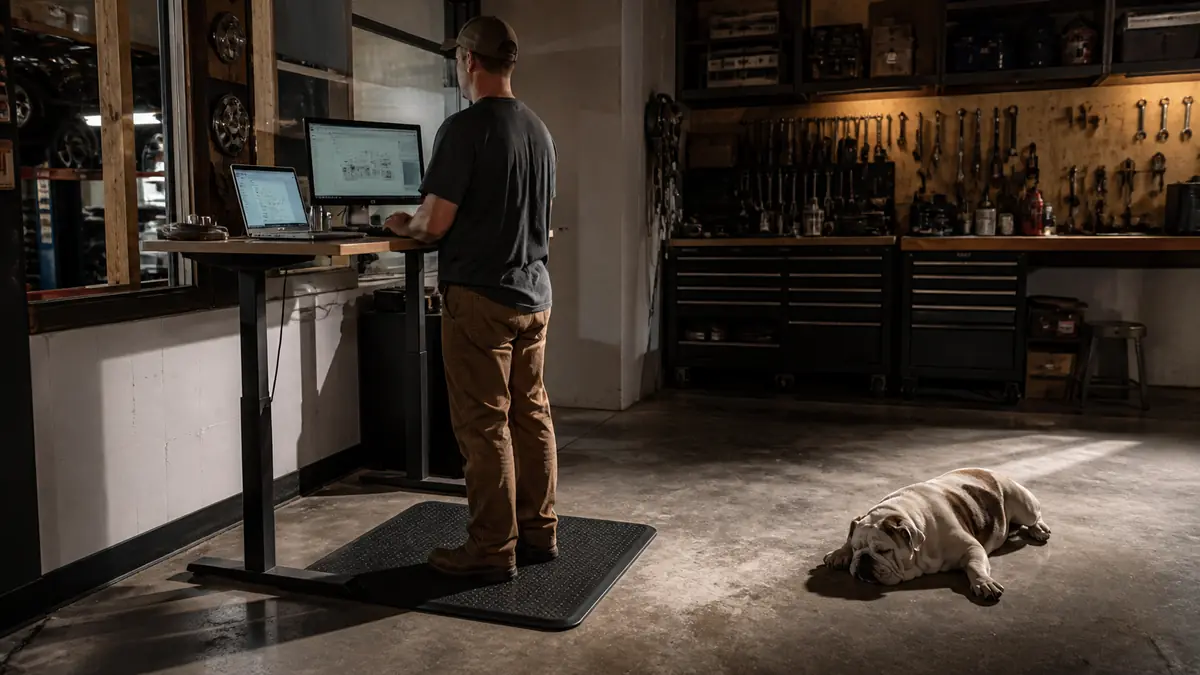
Three decades of shop floors taught me one thing about concrete: it fights back. You don't feel it the first hour. By the third, your heels are throbbing and your lower back starts talking to you, and by lunch you're leaning on whatever is handy because your legs are done. I'm a heavy equipment mechanic. I've stood on more concrete than most people will ever walk on, so when I finally set myself up a standing desk in the corner of my garage, I didn't need anybody to sell me on the idea that my legs wanted an anti-fatigue mat. I had a different question about the FEATOL mat specifically. Would the thing actually be built right, or was it another gadget that looks good in a picture and falls apart in a month?
Let me tell you what I tried before I broke down and bought one. A scrap of rubber stall mat from the shop, cut to fit. It cushioned nothing, smelled like a barn, and slid under my boots on the concrete. A folded piece of cardboard box under each foot. Flat and useless before the week was out. An old tire mat that belonged on a truck floor. Hard as a rock. I wanted something that actually gave under my weight and then came back, something that would earn its spot the way I judge any tool. So I ordered the FEATOL mat and put it on the concrete in front of my desk. Six months later, it's still there, and I've stood on it for a good chunk of every workday since.
The Quick Verdict
After six months of daily standing on concrete, this mat does its job. The thick padding genuinely eases my legs and lower back, and it has held up better than I expected. It is not a cure for bad habits, and the edges will show a little wear if you catch them with your chair, but for the money it earns its place under a standing desk.
Amazon Check Today's Price →Your concrete floor has been winning far too long. This is the fix.
I stand on concrete for a living, and six months in, this is the mat that made the difference for me. If you run a standing desk on a hard floor, your legs are asking for the same cushion. Check today's price on Amazon and see for yourself.
Amazon Check Today's Price on Amazon →How I've Used It
My setup is simple. I moved my laptop and a monitor onto a standing workbench I built out of the same steel and wood I use for the hot rods, in the corner of the garage that used to be just tool storage. The floor there is bare concrete, the same floor I've stood on for years. I raised the desk so the top of the monitor sits about level with my eyes, and I put the FEATOL mat right where my boots land.
How much do I actually stand? More than I planned. I take video calls with parts suppliers and customers, I chase invoices, I price jobs, and I write out the notes I used to scribble on grease-smudged paper. That adds up to most of the day at a desk. On heavy days I'm on my feet for six or seven hours, not all at once, but long enough that my legs used to complain every single evening. The bulldog, Dozer, sleeps on the concrete a few feet away and thinks the whole arrangement is fine, which says more about his priorities than about the mat.
One thing I did from day one: I move around. I shift weight, I step back and forth, I take a walk around the shop between calls. The mat is not a crutch, it's a cushion. It takes the sting off the concrete so my legs can last the full day, but I still do my part. That pairing, mat plus movement, is what actually got my evenings back.
What's Actually Under Your Feet
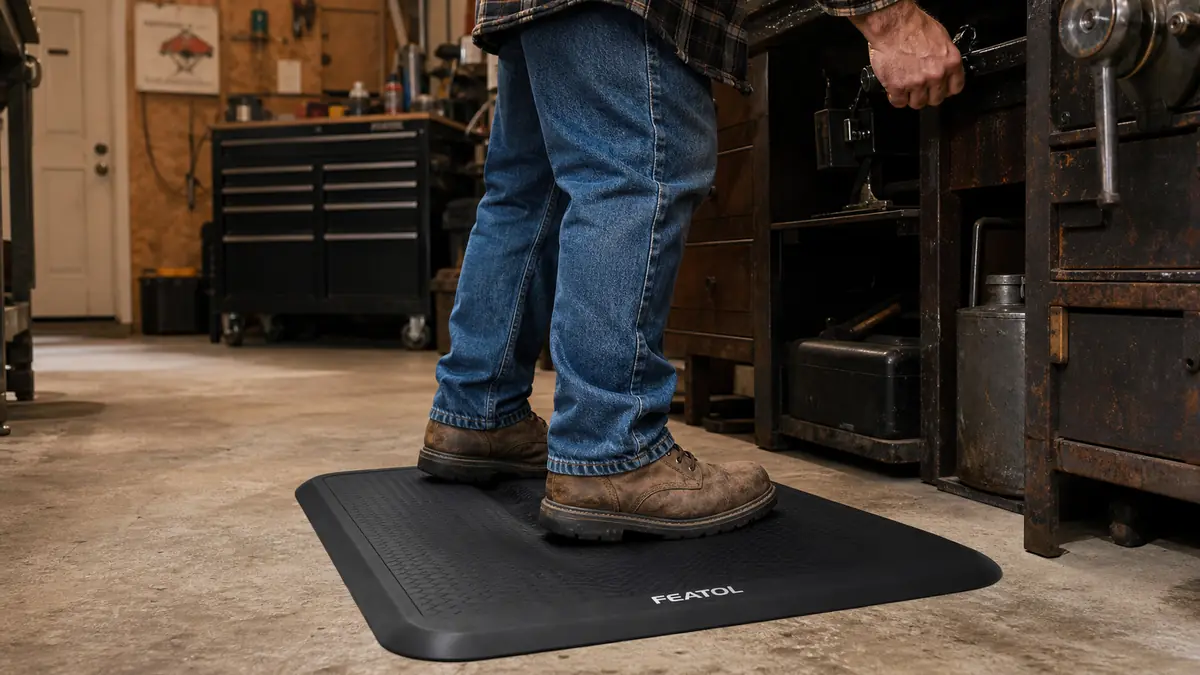
The headline number on this mat is the thickness. It comes in around nine-tenths of an inch of memory foam, and for a guy who spends his life judging whether a part has the right meat to it, that's the first thing I checked. You want cushion, and cushion is what this has. When I step on it, my boots sink in a little, and the foam gives then comes back. That give is the whole trick. A thin mat just rattles your heels against the floor. This one actually sits between you and the concrete.
The back of the mat is a grippy rubber that holds it to the concrete. That was a real question for me, because my earlier stall-mat experiment slid all over the place. This one has not moved an inch since I laid it down. No curling at the corners, no creeping under my desk, no fighting it back into place every morning. For a guy who hates redoing work, that matters.
The top surface is fairly smooth, which suits me. I'm not dragging a rolling office chair across it all day, I'm standing on it in work boots, and I'd rather it not grab at my feet. If you plan to roll a chair onto the mat, the smoother top works better than a deeply textured one, though you'll still have a lip where the mat ends. I'll come back to that lip, because it's the one thing about the design I'd flag.
Six Months of Standing Days
The first week, I noticed the difference mostly in my heels. That dull ache I used to carry by mid-afternoon just was not there anymore. I was genuinely surprised, and a little annoyed at myself for not buying one years ago. The second thing I noticed was how my lower back settled down. Standing on concrete with your knees locked is a sure way to load up the low back, and the cushion took the worst of that sting off.
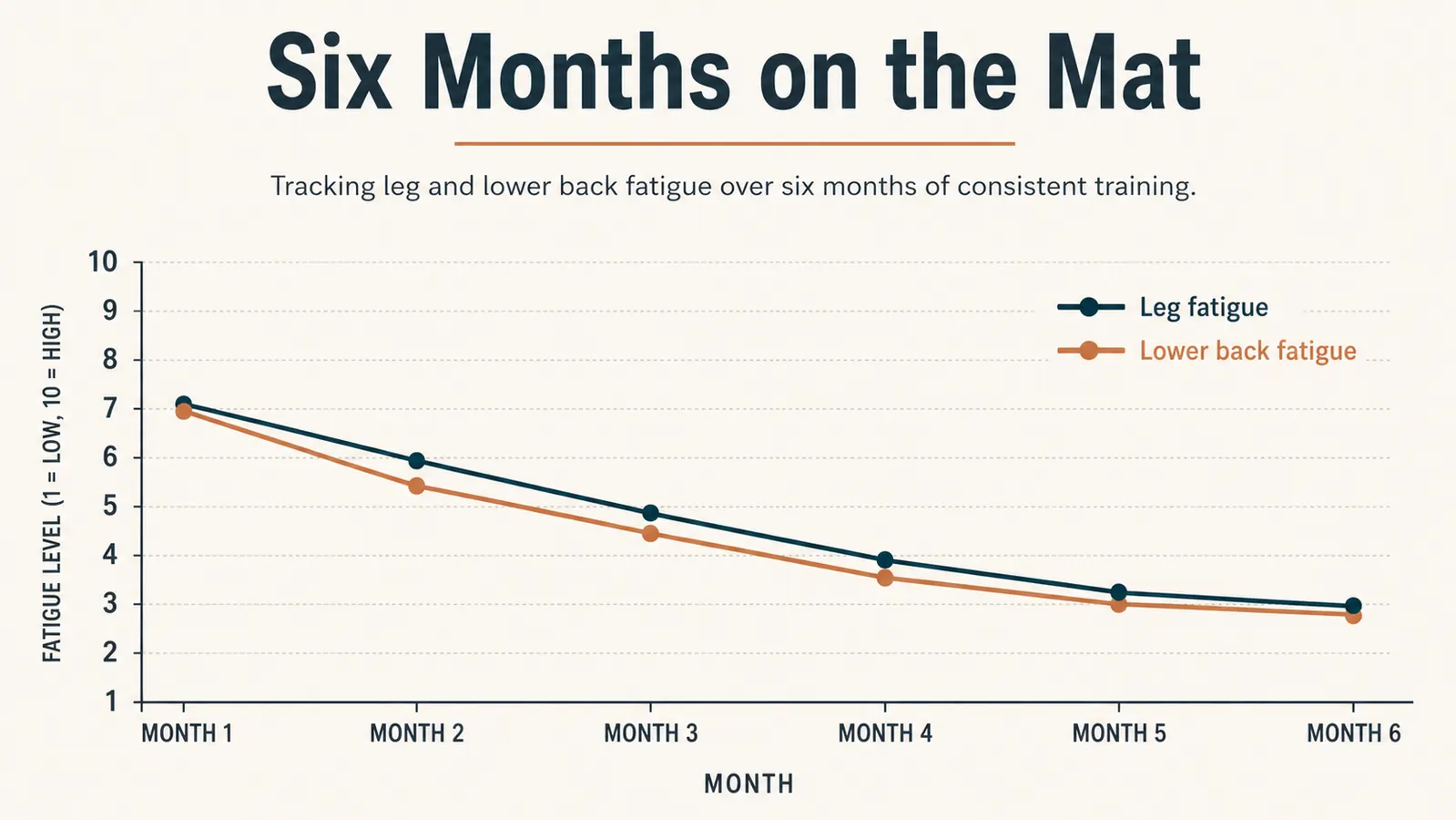
By the three-month mark, I was standing more and sitting less, which is exactly what I wanted. My legs were lasting the whole day without me planting myself in a chair to baby them. I tracked it loosely, because I'm a mechanic not a scientist, and the honest read is that my leg and back fatigue dropped from a rough seven out of ten on hard days to about a three. That number is not a real measurement, but the direction is real, and I felt it.
Durability has been better than I hoped for. Six months of daily use, boots on, and the foam has not flattened out or gone dead. That was my main worry, that a soft mat would pancake into a hard slab after a few months and I'd be back where I started. It has not happened. The mat still gives the way it did on day one. The edge I flagged earlier, though, is a real con. The mat is thick, which is great underfoot, but that thickness makes a small step up at the borders. I've caught it a couple of times with my toe, and a rolling chair wants to bump over it rather than roll clean. It is not a deal breaker, but it is the one thing I'd redesign if I could.
The dull heel and low-back ache I carried every evening are simply not there anymore. For a guy who stands on concrete for a living, that is the whole review.
The Tradeoffs I'll Be Honest About
No piece of gear is perfect, and I don't trust reviews that say otherwise. So here's the honest list. The mat is not as 'custom' as some pricier standing mats, and if you want a mat that covers a wide area or tucks neatly around a big desk, you might find the size a touch snug. Mine sits exactly where my boots land, which is all I ask, but measure your space before you order.
The top is a magnet for dust and shop grime. If I wore shoes into the house it wouldn't matter, but I'm standing on it in boots that have been out on the floor, and every so often I wipe the surface down. It cleans up fine with a damp rag, but it is not a set-it-and-forget-it surface if you live in a shop like mine.
And it will not fix your posture. I say this because plenty of reviews treat a mat like it cures everything. It does not. If you stand with your knees locked and your shoulders hunched, this mat will make your legs happier while your habits stay bad. You still have to stand with your weight even, keep your monitor at eye level, and move. The mat is the cushion, not the cure.
How It Compares to What I Tried Before
The more I used it, the more I understood what separates this from the cheap options I started with. My old stall mat was hard, smelled, and slid. This has real foam and stays put. A flimsy foam exercise mat I also tested packs flat under a standing weight and leaves your heels right back on the concrete. This one does not. The honest comparison that keeps coming up for me is a cheap gym mat, and I break that apart in a separate piece if you want the full rundown.
The short version is that a gym mat is thin, soft when new, and dead in a matter of weeks under a standing adult's weight. It is fine for lying on while you stretch and wrong for standing on all day. This mat is built to take body weight for hours and come back. That is the difference between something designed for the job and something you hope will happen to work.
What I Liked
- Thick memory foam that genuinely cushions, so leg and back fatigue dropped noticeably for me
- Grippy rubber backing that has not slid an inch on concrete in six months
- Held up well, the foam has not flattened out or gone dead under daily use
- Smooth top that works fine in work boots and won't grab at your feet
- Simpler and cheaper than any dedicated 'ergo' mat I looked at, without giving up cushion
Where It Falls Short
- The thick edge leaves a small lip, so a rolling chair bumps over it and you can catch a toe
- Surface picks up dust and grime and needs the occasional wipe in a shop setting
- It cushions, it does not fix your posture, you still have to stand and move right
The mat is the cushion, not the cure. It takes the sting off the concrete so I can last the full day, but I still do my part.

Who This Is For
This is for anyone who runs a standing desk on a hard floor and wants to end the day without a dull ache in their heels and lower back. If you stand for long stretches, whether you talk on calls, do paperwork, type, or work the way I do, this mat takes the worst of the concrete out from under you. It is built for the person who would rather buy one tool that works than three gadgets that sit in a drawer.
Who Should Skip It
Skip it if you mostly sit and only stand for ten minutes here and there. You will not notice the cushion enough to justify it. Skip it if you plan to roll a heavy chair across the whole surface, because that thick edge will bug you. And skip it if you are looking for a tool that will fix your posture by itself, because no mat will do that. Buy it for the cushion, not the cure.
I should tell you what surprised me about the FEATOL after a winter on it. The first month, I was skeptical. The foam felt firm in the cold of the garage, almost like it was resisting me, and I figured that was the start of the breakdown. It was not. The foam softened up as the floor warmed under my feet, and it stayed consistent through February, when the concrete was cold enough to suck the heat out of my socks. By March I noticed my lower back was quiet on Friday afternoons in a way it had not been in years. That is the only metric I trust for a tool like this. Not the color, not the marketing, not the bounce. Whether my back is quiet at the end of a week. So far, the answer has been yes. I will keep standing on it through next winter too, and I will let you know if that changes.
Six months in, this mat is still doing its job on my concrete floor.
Your legs have been doing the hard part of standing on a hard floor long enough. This is the mat that finally took the sting off for me, and it has held up since the day I laid it down. Check today's price on Amazon and give your heels the same break.
Amazon Check Today's Price on Amazon →